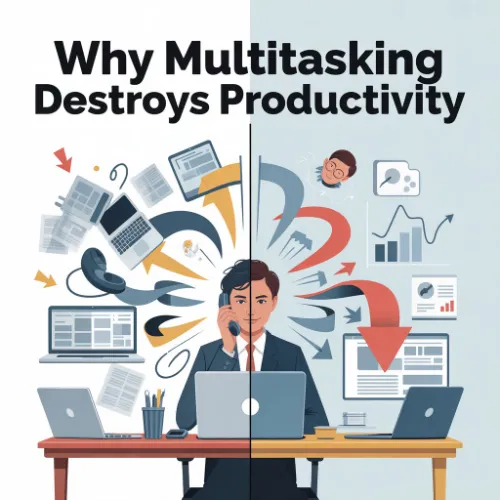
Multitasking destroys productivity because your brain cannot focus on multiple demanding tasks at once.
Each switch drains attention, slows thinking, and increases mistakes. Doing one thing at a time produces better results faster.
What is multitasking? 🤔
Multitasking means switching attention between two or more tasks. It is not doing tasks simultaneously. It is rapid task switching.
Your brain pauses one task, loads another, then reloads the first. That reload costs energy and time.
Why does multitasking feel productive? ⚡
Multitasking feels productive because you stay busy. Notifications, messages, and quick tasks create constant stimulation.
Busy does not equal effective. Activity masks lost focus.
Why multitasking lowers productivity 🧠
Your brain has limited attention. Every switch creates friction.
What happens when you multitask:
• Focus drops
• Errors increase
• Tasks take longer
• Mental fatigue rises
• Motivation falls
This effect compounds across the day.
Read more: How Multitasking Affects Productivity and Brain Health
How task switching actually works 🔁
Each time you switch tasks, your brain pays a “switching cost.”
That cost includes:
• Time to refocus
• Lost context
• Increased cognitive load
Studies on attention consistently show task switching can reduce efficiency by up to 40 percent in complex work.
How multitasking affects your brain and body ⚠️
| Area affected | What happens | Result |
|---|---|---|
| Attention | Focus fragments | Shallow work |
| Memory | Information retention drops | More mistakes |
| Stress | Cortisol rises | Faster burnout |
| Energy | Mental fatigue builds | Lower output |
| Motivation | Tasks feel heavier | Procrastination |
Why multitasking increases mistakes ❌
When attention splits, details slip.
You miss instructions. You misread messages. You forget steps. Errors require rework, which costs more time than focused work.
Accuracy drops before speed drops.
Why multitasking causes mental exhaustion 😵💫
Constant switching keeps your brain in alert mode. That burns energy fast.
By midday, you feel tired without physical effort. This is cognitive fatigue, not laziness.
Mental exhaustion shows up as:
• Brain fog
• Irritability
• Short attention span
• Decision fatigue
Why multitasking kills deep work 🎯
Deep work requires uninterrupted focus. Multitasking breaks that state before it forms.
Without deep work:
• Complex thinking suffers
• Creativity drops
• Learning slows
Shallow work fills the day but produces little progress.
Is multitasking ever useful? ⚖️
Yes, but only with low-effort tasks.
Acceptable multitasking examples:
• Folding laundry while listening to a podcast
• Walking while thinking
• Cooking while music plays
Avoid multitasking when tasks require thinking, writing, problem-solving, or decision-making.
How multitasking affects motivation 🔋
Multitasking makes tasks feel endless.
You start many things but finish few. Completion satisfaction disappears. Motivation fades.
Progress fuels motivation. Multitasking blocks progress.
Why digital distractions make it worse 📱
Phones train constant switching.
Notifications interrupt focus before it stabilizes. Each interruption restarts the mental process.
Frequent interruptions can take 20 minutes or more to fully recover focus.
Also helpful: Signs of Burnout You Should Not Ignore 🔥
How to stop multitasking and work better ✅
You do not need extreme systems. Simple changes work.
Practical ways to reduce multitasking:
• Do one task per time block ⏱️
• Silence non-essential notifications 🔕
• Close unused tabs ❌
• Batch messages and emails 📬
• Use short focus sessions, 25 to 45 minutes 🎯
Start small. One focused block beats hours of scattered work.
Single-tasking habits that improve productivity ⚡
Build habits that protect focus.
Helpful habits include:
• Clear daily priorities
• One main task per block
• Defined start and stop times
• Short breaks between blocks
Structure reduces mental load.
What to do when your job demands multitasking 🧩
Some roles require responsiveness. You can still reduce damage.
Try this:
• Group similar tasks
• Set response windows
• Communicate availability clearly
• Protect one deep-focus block daily
Control what you can.
How long does it take to retrain focus? ⏳
Focus improves faster than most people expect.
Many notice benefits within:
• 3 to 5 days of reduced switching
• 1 to 2 weeks of focused blocks
• Ongoing gains with consistency
Focus is a skill. Skills improve with practice.
Key takeaway 🧠✅
Multitasking feels efficient but reduces productivity, focus, and energy. Task switching drains mental resources and increases mistakes. Single-tasking produces better results in less time.
Protect your attention. Your productivity depends on it.
Try one focused work block today. Silence notifications and finish one task fully. Explore more Mindset and Motivation guides on FeedFrenzyPlus 💚

I’m Geraldine Villariza, an SEO Specialist with over 3 years of experience. I’m passionate about beauty, self-care, and helping others thrive. I’ll be discussing topics like lifestyle, beauty, health and wellness, life hacks, daily tips, mindset and motivation, productivity, relationships, and love — all to help you live a more balanced and fulfilling life.