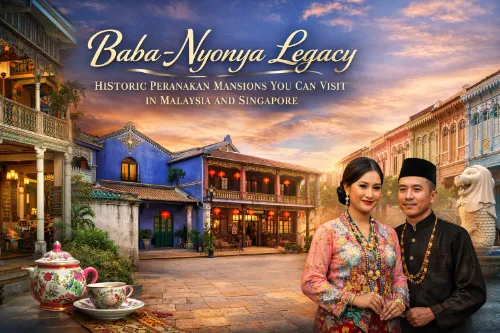
Step inside a Peranakan mansion and you immediately feel it — the air is softer, the light filters differently, and every surface tells a story.
These are not just old houses. They are living records of Peranakan heritage, where Chinese, Malay, and European influences blended into something uniquely Southeast Asian.
From the grand halls of Penang’s Pinang Peranakan Mansion to the intimate rooms of a preserved townhouse in Melaka’s Baba & Nyonya Heritage Museum, and the pastel Peranakan shophouses of Katong and Joo Chiat in Singapore, each space reflects the refined world of the Baba Nyonya, also known as the Straits Chinese.
If you want to experience authentic Peranakan mansions in Malaysia and Singapore, this guide will help you see them not just as tourist stops — but as cultural time capsules.
What “Peranakan” Means — and Why These Mansions Matter
The word Peranakan literally means “locally born.” In Malaysia and Singapore, it commonly refers to descendants of early Chinese settlers who intermarried with local Malay communities.
The men were known as Baba, the women as Nyonya, and their hybrid culture became one of Southeast Asia’s most distinctive identities.
(You can explore a broader cultural overview via the National Heritage Board Singapore.)
These families expressed status, refinement, and cultural pride through their homes.
A true Peranakan mansion is recognizable for its:
- Spacious internal courtyards designed for light and ventilation
- Intricate ornate woodwork and hand-carved panels
- Colorful ceramic floor tiles, sometimes imported from Europe
- Rooms filled with heirloom furniture, delicate porcelain, and curated antiques and collectibles
- Displays of nyonyaware, embroidery, and traditional garments like the sarong kebaya
This architectural fusion is often described as Straits Eclectic style, a hybrid aesthetic blending Chinese, Malay, and European influences (see overview on Straits Eclectic architecture).
MALAYSIA: The Best Peranakan Mansions to Visit
1) Pinang Peranakan Mansion (George Town, Penang)
If you only visit one Peranakan mansion in Malaysia, make it this one.
Located in George Town, the Pinang Peranakan Mansion is widely considered the most visually impressive Peranakan mansion museum in the country. The mansion showcases over 1,000 pieces of antiques and collectibles within a restored heritage residence once known as Hai Kee Chan.
It is historically associated with Chung Keng Quee, who held the title of Kapitan Cina in Penang’s colonial era.
What makes it unforgettable
Walking through its halls feels immersive rather than instructional. The layout flows from reception areas into private chambers, showing how wealth and hospitality were expressed through architecture.
Look closely and you’ll notice:
- Polished patterned ceramic floor tiles
- Deep-toned carved doors with ornate woodwork
- Antique cabinets displaying fine porcelain
- Formal dining rooms staged with period furniture
- Ritual objects tied to Peranakan ceremonies
The mansion sits within the UNESCO World Heritage city of George Town, which you can explore further through the official George Town World Heritage Incorporated site.
2) Cheong Fatt Tze Mansion (The Blue Mansion), Penang
Often included in Penang’s heritage circuit, the Cheong Fatt Tze Mansion — also known as The Blue Mansion — complements the Peranakan mansion experience.
The mansion operates structured daily guided tours, and advance booking is recommended due to limited capacity. You can find updated tour times on their official daily tours page.
Why include it?
Although not strictly a Baba-Nyonya family home, the Blue Mansion reflects the same heritage-era grandeur and courtyard planning seen in many Peranakan heritage houses.
Highlights include:
- A dramatic open-air courtyard
- Symmetrical design and heritage restoration
- Blended architectural elements reflecting regional trade influence
Together with Pinang Peranakan Mansion, it gives you a broader understanding of heritage mansions in Penang.
3) Baba & Nyonya Heritage Museum (Melaka / Malacca)
For a more intimate experience, head to Melaka.
The Baba & Nyonya Heritage Museum is a preserved townhouse originally acquired by the Chan family in 1861, combining three terrace lots into one cohesive heritage residence.
Located along the heritage streets near Jalan Tun Tan Cheng Lock, the museum sits within Melaka’s historic district — officially recognized under the UNESCO World Heritage listing for Melaka and George Town (see UNESCO details here:
https://whc.unesco.org/en/list/1223/).
Why it stands out
Unlike grand mansions, this house feels deeply personal.
Inside you’ll see:
- Bedrooms staged with heirloom pieces
- Formal dining spaces reflecting Peranakan hospitality traditions
- Cabinets displaying nyonyaware
- Traditional garments including the embroidered sarong kebaya
It offers one of the clearest windows into Peranakan domestic life in Malaysia.
SINGAPORE: Where to See Peranakan Homes
Singapore’s Peranakan experience blends preserved neighborhoods with curated museum interpretation.
4) Katong & Joo Chiat — A Living Heritage District
The Katong-Joo Chiat district is widely recognized as Singapore’s Peranakan cultural hub.
Here, rows of restored heritage shophouses reflect Peranakan design features:
- Pastel facades
- Ornamental tiles
- Decorative motifs
- The iconic “five-foot way” walkway typical of Southeast Asian shopfront architecture
This neighborhood demonstrates how Peranakan architectural influence evolved into urban residential forms.
5) Koon Seng Road — Singapore’s Most Photographed Peranakan Street
If you search for Peranakan houses in Singapore, Koon Seng Road consistently appears in tourism guides.
This residential street is known for its colorful Peranakan-style shophouses and restored facades.
What you’ll see:
- Vibrant painted exteriors
- Decorative ceramic tile detailing
- Window frames adorned with carved elements
While these are not grand mansions like in Penang, they represent the urban expression of Peranakan heritage.
6) Peranakan Museum (Singapore)
To fully understand what you see in Malaysian mansions or Singapore’s shophouses, visit the Peranakan Museum.
Operated by Singapore’s National Heritage Board, the museum reopened after a major renovation with refreshed galleries highlighting Peranakan fashion, craft, and identity.
You’ll find:
- Fine nyonyaware
- Intricate beadwork
- Embroidered sarong kebaya
- Ceramics and ritual objects
- Textiles including traditional batik
The museum connects the decorative objects found in Peranakan mansions to the broader story of Southeast Asian cultural exchange.
What to Look for Inside Peranakan Mansions
When visiting, observe intentionally.
Architecture
- Airy internal courtyards
- Symmetry and layered planning
- Decorative elements characteristic of Straits Eclectic style
Materials
- Patterned ceramic floor tiles
- Imported European tiles
- Polished timber with detailed ornate woodwork
Cultural Objects
- Formal dining sets
- Heirloom furniture
- Fine porcelain
- Carefully preserved antiques and collectibles
- Traditional attire such as the sarong kebaya
- Handcrafted beadwork
These features distinguish Peranakan mansions from other heritage homes across Southeast Asia.
Final Thoughts
The legacy of the Baba-Nyonya lives on through architecture, craft, textiles, and urban streetscapes across Malaysia and Singapore.
Whether you stand beneath the carved beams of a Penang mansion, walk the heritage streets of Melaka, or admire the pastel Peranakan shophouses of Katong, you are witnessing a culture that mastered the art of blending worlds.
Peranakan mansions are not just preserved buildings.
They are living stories — and some of Southeast Asia’s most beautiful heritage spaces you can still walk through today.

I’m John Michael Palmes, an SEO practitioner with over three years of hands-on experience in search engine optimization and digital marketing. I help websites improve visibility, build effective SEO content strategies, and rank better on Google using practical, data-driven approaches.
My focus is on on-page SEO, keyword research, and content optimization—the fundamentals that help both search engines and users understand a site clearly. I continuously test, analyze results, and refine strategies, sharing honest and actionable SEO insights as search algorithms evolve.