
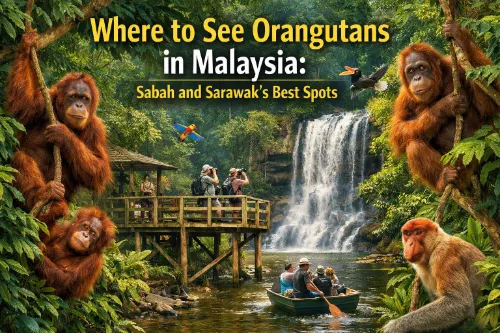
Malaysia is one of the best places in the world to see orangutans in their natural rainforest home. The most rewarding encounters happen in Malaysian Borneo, in the states of Sabah and Sarawak, where protected forests, rivers, and rehabilitation centres give you several ways to meet these incredible great apes.
The best places to see orangutans in Malaysia are in Sabah (Sepilok, Kinabatangan River, Danum Valley, Deramakot or Tabin) and Sarawak (Semenggoh, Matang, Batang Ai).
Below, you will find a simple, practical guide to where to see orangutans in Malaysia, how to choose between Sabah and Sarawak, and how to visit ethically while supporting conservation.
Best places to see orangutans in Malaysia
If you want the short answer first, these are the top spots:
- Sepilok Orangutan Rehabilitation Centre, Sabah – Easiest, most reliable semi‑wild encounters near Sandakan.
- Kinabatangan River (Sukau/Bilit/Abai), Sabah – High‑density wildlife river cruises with good chances to see orangutans.
- Danum Valley Conservation Area, Sabah – Deep primary jungle with fully wild orangutans and other rare wildlife.
- Deramakot Forest Reserve, Sabah / Tabin Wildlife Reserve, Sabah – Remote, low‑crowd forests with strong wildlife focus.
- Semenggoh Wildlife Centre, Sarawak – Semi‑wild orangutans close to Kuching, ideal for short trips.
- Matang Wildlife Centre, Sarawak – Rehabilitation‑focused centre for conservation‑minded visitors.
- Batang Ai National Park, Sarawak – True wild habitat where orangutans live far from mass tourism.
These places together cover both easy access and more adventurous options, so you can match your orangutan experience to your time, budget, and comfort level.
Understanding orangutans in Malaysian Borneo
The orangutans you see in Malaysia are Bornean orangutans, a critically endangered subspecies that lives only on the island of Borneo. Their numbers have dropped because of habitat loss, hunting, and the expansion of agriculture, especially palm oil plantations.
Visiting responsible orangutan sanctuaries and joining conservation‑focused tours helps fund forest protection, research, and education for local communities.
You will encounter three types of settings:
- Wild habitat in national parks and forest reserves, where orangutans live completely free.
- Semi‑wild environments around rehabilitation centres, where rescued orangutans roam forest but may visit feeding platforms.
- Captive or non‑ethical attractions, where orangutans are kept mainly for entertainment and often allow touching or photos.
For a responsible trip, aim for wild and semi‑wild experiences and avoid any place that advertises close contact, feeding, or posing with orangutans.
Best places to see orangutans in Sabah
Sabah is usually the first choice for travellers who want to see orangutans in Malaysia. It has good infrastructure, many wildlife lodges, and multiple orangutan hotspots within a short flight of each other, so Sabah orangutan encounters are relatively easy to plan even for a first‑time visitor.
Sepilok Orangutan Rehabilitation Centre
The Sepilok Orangutan Rehabilitation Centre is one of the most famous orangutan sanctuaries in Malaysia. Located near Sandakan, it rescues orphaned and injured orangutans, teaches them forest skills, and, when possible, releases them into surrounding protected forest.
At Sepilok, orangutans live in the rainforest and are free to come and go. Visitors stand on wooden boardwalks and viewing platforms, especially around two daily feeding times, to watch semi‑wild orangutans move through the trees.
It is one of the best places to see orangutans in Malaysia if you want a high chance of sightings without long hikes.
- First‑time visitors who want a simple, organised visit.
- Families and older travellers who prefer boardwalks and short walks.
- Anyone interested in the story of rehabilitation and release.
Next door, the Bornean Sun Bear Conservation Centre offers another look at unique Malaysian wildlife, making Sepilok a strong one‑day wildlife hub.
Kinabatangan River (Sukau, Bilit, Abai)
If you picture yourself on a small boat at sunrise, mist over the water, and orangutans feeding in trees along the river, the Kinabatangan River is for you. This is one of the main Malaysian Borneo orangutans areas and a hotspot for many other species.
Villages like Sukau, Bilit, and Abai host river lodges that offer Kinabatangan River wildlife cruises. These boat trips happen mainly at dawn and dusk, when animals are most active, and you drift along side channels watching for orangutans, proboscis monkeys, hornbills, crocodiles, and more.
A typical Kinabatangan stay includes:
- Two to three nights in a riverside lodge.
- Sunrise and late‑afternoon river safaris to spot orangutans and other wildlife.
- Optional night cruises or short jungle walks near the lodge.
This is one of the easiest river safaris to spot orangutans because the forest is narrow and wildlife tends to concentrate near the water, making it excellent if you want to see orangutans in the wild in Malaysia without strenuous trekking.
Danum Valley Conservation Area
Danum Valley Conservation Area is a dream destination for serious wildlife and rainforest lovers. It protects a large area of primary rainforest, with towering trees, rich biodiversity, and a strong population of fully wild orangutans.
In Danum, there are no feeding platforms or guaranteed sightings. Instead, you join guided hikes on forest trails, climb canopy walkways, and join night drives to look for nocturnal animals, so Danum Valley Conservation Area orangutans encounters feel particularly special because they happen completely on the animals’ terms.
A stay in Danum often includes:
- Accommodation in a forest lodge or research‑style centre.
- Daily guided walks with naturalists who help find orangutans, gibbons, and birds.
- Night drives to search for civets, flying squirrels, and other nocturnal wildlife.
This destination suits travellers who enjoy deep immersion in nature and accept that wild sightings are never guaranteed.
Deramakot Forest Reserve and Tabin Wildlife Reserve
For a more off‑the‑grid trip, look at Deramakot Forest Reserve and Tabin Wildlife Reserve. These two areas are less famous than Sepilok or the Kinabatangan but are strongly valued by wildlife photographers and conservation‑minded visitors.
Deramakot Forest Reserve orangutan sightings are sought after because the area is an FSC‑certified forest managed to balance reduced‑impact logging with conservation, and night drives can be excellent for finding rare species as well as orangutans. Tabin Wildlife Reserve also offers guided walks, night safaris, and wildlife‑focused stays in a quieter forest setting.
Both Deramakot and Tabin usually require more time, more complex logistics, and a slightly higher budget than the more mainstream spots, but they reward you with fewer crowds and a stronger feeling of being deep in the wild.
Best places to see orangutans in Sarawak
Sarawak gets fewer visitors than Sabah, which means quieter forests and a more relaxed pace. Sarawak orangutan experiences are often easier to access from Kuching, making it a great choice if you like combining a laid‑back city with nature and culture.
Semenggoh Wildlife Centre
Semenggoh Wildlife Centre is the most popular place to see orangutans near Kuching. It is a semi‑wild orangutan reserve where rehabilitated orangutans live in the surrounding forest and may come to feeding platforms at set times, so Semenggoh Wildlife Centre Sarawak visits are usually organised around morning or afternoon feeding sessions.
Rangers put out food on a platform, and orangutans may choose to appear, though sightings are not guaranteed, especially when wild fruits are plentiful. Semenggoh is ideal if you are based in Kuching, prefer easy walks, and want to support a rehabilitation‑focused centre while still feeling close to the forest.
Matang Wildlife Centre
Matang Wildlife Centre orangutans visits are more about understanding rehabilitation than chasing sightings in a “perfect” forest setting. Matang, part of Kubah National Park, cares for orangutans and other animals that are being treated, rehabilitated, or cannot be released.
As a visitor, you see enclosures and forested areas where animals are prepared for release or given long‑term care, which gives a behind‑the‑scenes look at orangutan rehabilitation centres in Malaysia and suits travellers particularly interested in conservation work.
Batang Ai National Park
Batang Ai National Park orangutans live in a remote area of forest that is far from mass tourism. The park’s rainforest is a stronghold for wild orangutans, but the forest is dense and sightings are rare, so most visits here are about supporting conservation, enjoying the forest, and experiencing local culture.
Getting to Batang Ai usually involves a combination of road travel and boat rides, often combined with stays in traditional Iban longhouses, making it a good option if you want both cultural immersion and a chance, however small, of seeing truly wild orangutans.
Sabah vs Sarawak: which should you choose?
The Sabah vs Sarawak decision for orangutans usually depends on accessibility, likelihood of sightings, crowd levels, and the feel you want from your trip.
Sabah is often better if you want higher chances of seeing orangutans, prefer clear tourism infrastructure and many tour operators, and like the idea of combining Sepilok, Kinabatangan River wildlife cruises, and Danum Valley Conservation Area orangutans in one loop.
Sarawak is often better if you prefer quieter destinations, like easy day trips from Kuching to Semenggoh Wildlife Centre and Matang Wildlife Centre, and want to add longhouse culture and remote forest like Batang Ai National Park to your itinerary.
If you have the time and budget, you can visit both and experience different sides of orangutans Malaysia Sabah Sarawak wildlife in one extended trip.
When to go and how long to stay
You can see orangutans in Malaysia all year, but some periods are more comfortable for travel because drier months usually mean easier river conditions and less muddy trails. As a simple planning guide, spend at least 3–4 days in Sabah if you want to visit Sepilok and the Kinabatangan River, and add several more days if you also want Danum Valley, Deramakot Forest Reserve, or Tabin Wildlife Reserve.
In Sarawak, plan 3–4 days around Kuching for Semenggoh Wildlife Centre and Matang Wildlife Centre, and longer if you also go to Batang Ai National Park, with many travellers spending 7–10 days in Malaysian Borneo to combine several of the best places to see orangutans in Malaysia.
Ethical orangutan tourism tips
Ethical orangutan tourism in Borneo matters for the survival and wellbeing of these animals. When people talk about ethical orangutan tourism in Borneo or responsible wildlife viewing guidelines in Malaysia, they are pointing to real behaviours that directly affect orangutans.
Follow these simple rules:
- Keep your distance and never try to touch or approach an orangutan, even if it comes close.
- Do not feed them, because human food can harm their health and change their natural behaviour.
- Avoid flash photography and loud noises, which can stress animals.
- Stay with your guide and on marked paths to protect the forest and keep yourself safe.
- Choose operators that limit group sizes, follow clear guidelines, and support conservation projects.
Seeing orangutans in the wild in Malaysia does not mean a guaranteed close‑up, and ethical tours will remind you that sightings depend on the animals, the season, and luck, with wild behaviour more important than perfect photos.
Practical travel tips for Sabah and Sarawak
A few simple logistics will help you plan where to see orangutans in Malaysia.
Getting there
For Sabah, fly into Kota Kinabalu as the main gateway, then take a short domestic flight to Sandakan for Sepilok and the Kinabatangan River, or to Lahad Datu for Danum Valley, Deramakot Forest Reserve, and some forest lodges.
For Sarawak, fly into Kuching, then join tours or use local transport to reach Semenggoh Wildlife Centre and Matang Wildlife Centre, and book organised trips if you want to continue onward to Batang Ai National Park.
Budget and accommodation
You will find a range of accommodation options at most orangutan sites, from budget guesthouses and simple lodges along the Kinabatangan to mid‑range and higher‑end eco‑lodges in Danum, Tabin, or Deramakot, as well as city hotels in Kota Kinabalu, Sandakan, and Kuching. Higher‑end lodges often bundle guided activities, meals, and transfers into one rate, which simplifies planning even if it raises the overall cost.
What to pack
Pack for hot, humid, and sometimes wet weather with light, breathable clothing, a light rain jacket, comfortable walking shoes or hiking boots, leech socks for wetter forests, binoculars, a camera with some zoom, and eco‑friendly toiletries and insect repellent to make your Malaysian Borneo orangutans experience more comfortable.
Sample orangutan‑focused itineraries (7–14 days)
To help you visualise your trip, here are simple example itineraries based on current common routes.
Sabah‑only (7–10 days)
- Day 1–2: Kota Kinabalu (arrival, rest, city food and markets).
- Day 3–4: Sandakan and Sepilok Orangutan Rehabilitation Centre (plus Sun Bear Centre).
- Day 5–6: Kinabatangan River wildlife cruises from Sukau or Bilit.
- Day 7–9: Danum Valley Conservation Area orangutans trekking and night drives (extend if you like slow travel).
If you have extra days, you can add Deramakot Forest Reserve orangutan sightings or Tabin Wildlife Reserve for more remote forest time.
Sarawak‑only (7–9 days)
- Day 1–3: Kuching city, local food, and nearby attractions.
- Day 2–3: Semenggoh Wildlife Centre and Matang Wildlife Centre orangutans.
- Day 4–7: Batang Ai National Park orangutans habitat and longhouse stays with Iban communities.
This route gives you quieter Sarawak orangutan experiences plus culture and river scenery.
Sabah + Sarawak combo (10–14 days)
For a fuller look at orangutans Malaysia Sabah Sarawak wildlife, combine the two by flying into Kota Kinabalu, continuing to Sandakan (Sepilok + Kinabatangan), then Lahad Datu (Danum or Tabin), and finally Kuching (Semenggoh, Matang, optional Batang Ai).
FAQ: seeing orangutans in Malaysia
Is there an ethical way to see orangutans in Malaysia?
Yes, there is, and resources like Malaysian Wildlife’s ethical orangutan guide explain how to choose recognised rehabilitation centres such as Sepilok and Semenggoh, join small‑group tours, and avoid any business that promotes touching, feeding, or posing with orangutans.
Can I see fully wild orangutans in Sabah and Sarawak?
Yes, but sightings are never guaranteed, and wild encounters are most likely in places like Danum Valley, Deramakot Forest Reserve, and Tabin Wildlife Reserve in Sabah, and remote parks such as Batang Ai National Park in Sarawak.
How many days do I need to see orangutans in Malaysia?
Plan at least 3–4 days in each region you choose to visit, with many travellers spending 7–10 days in Malaysian Borneo to combine several locations and increase their chances of seeing orangutans.
When is the best time of year to see orangutans in Malaysian Borneo?
Guides to seeing orangutans in Malaysia suggest the drier months, especially roughly April–September, as the most comfortable for travel and wildlife, though rehabilitation‑centre sightings can be less predictable in peak fruiting season.
Is it better to go to Sabah or Sarawak to see orangutans?
Sabah is usually better for first‑timers who want more tour options and a higher chance of sightings, especially around Sepilok and the Kinabatangan River, while Sarawak is better if you prefer quiet destinations, easy day trips from Kuching, and a mix of culture and remote rainforest.
Final thoughts: making your orangutan encounter count
Seeing orangutans in Malaysia is a powerful, emotional experience that can stay with you for life. Whether you choose accessible centres like Sepilok and Semenggoh, river lodges along the Kinabatangan, deep‑jungle retreats in Danum, or remote forests like Batang Ai, each visit can contribute to protecting Bornean orangutan habitat in East Malaysia. By travelling slowly, following responsible wildlife viewing guidelines in Malaysia, and supporting ethical operators highlighted by organisations like Malaysian Wildlife, you help ensure that future generations can also enjoy meaningful, respectful orangutan encounters in Malaysia.

I’m John Michael Palmes, an SEO practitioner with over three years of hands-on experience in search engine optimization and digital marketing. I help websites improve visibility, build effective SEO content strategies, and rank better on Google using practical, data-driven approaches.
My focus is on on-page SEO, keyword research, and content optimization—the fundamentals that help both search engines and users understand a site clearly. I continuously test, analyze results, and refine strategies, sharing honest and actionable SEO insights as search algorithms evolve.