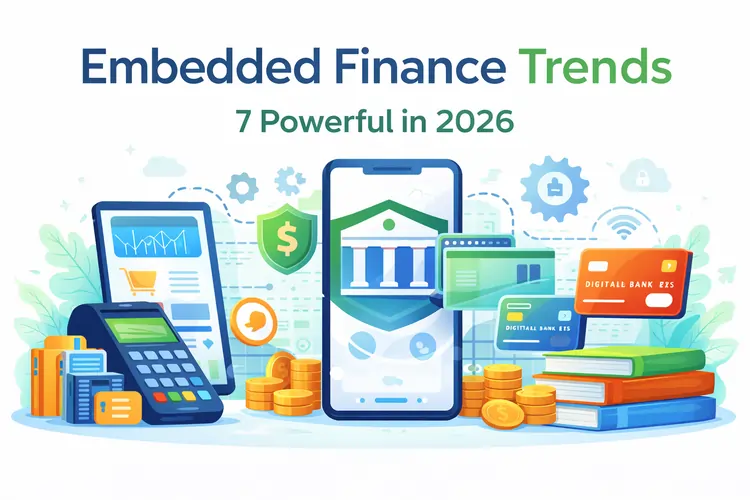
The Rise of Embedded Finance Trends in 2026
The financial services landscape is no longer confined to banks, credit unions, or traditional fintech apps. Today, financial products are seamlessly integrated into non-financial platforms—retail apps, ride-hailing services, SaaS platforms, marketplaces, and even social media ecosystems.
This structural shift is driving what experts now call one of the most transformative movements in modern fintech: embedded finance trends.
From embedded payments and lending to insurance and wealth management integrations, businesses are turning into financial distribution channels.
The rapid acceleration of APIs, Banking-as-a-Service (BaaS), open banking frameworks, and digital identity systems is fueling these embedded finance trends at scale.
Understanding embedded finance trends is essential for CEOs, founders, product leaders, and investors who want to remain competitive in an increasingly platform-driven economy. These trends are not simply technical upgrades—they represent a shift in how value is created, monetized, and delivered to customers.
This comprehensive guide explores the most important embedded finance trends shaping 2026 and beyond, analyzing their opportunities, risks, regulatory implications, and long-term strategic impact.
Understanding Embedded Finance
Embedded finance refers to the integration of financial services directly into non-financial platforms. Instead of redirecting customers to banks or third-party providers, businesses embed payments, lending, insurance, or banking features within their user journeys.
Examples include:
- A marketplace offering instant working capital loans to sellers
- A ride-sharing app providing driver debit cards
- An eCommerce store offering Buy Now, Pay Later at checkout
- A SaaS platform integrating invoicing and payroll services
These use cases illustrate why embedded finance trends are reshaping digital commerce and platform ecosystems.
Why Embedded Finance Is Accelerating in 2026
Several structural forces are driving current embedded finance trends:
- Growth of API-first infrastructure
- Expansion of Banking-as-a-Service providers
- Open banking regulations
- Demand for seamless user experiences
- Increased digital platform adoption
- Declining trust in traditional banking institutions
Consumers expect frictionless experiences. Businesses want new revenue streams. Financial institutions seek distribution expansion. These aligned incentives explain why embedded finance trends continue gaining momentum globally.
1. Embedded Payments as a Default Standard
Embedded payments remain the foundation of all major embedded finance trends.
Platform-Native Payment Infrastructure
Marketplaces and SaaS platforms increasingly manage their own payment flows rather than relying entirely on third-party processors. This gives them control over:
- Data ownership
- Transaction fees
- Customer relationships
- Settlement timing
Strategic Implications
Embedded payments increase conversion rates and reduce cart abandonment. They also unlock additional financial services such as embedded lending and treasury management.
Among all embedded finance trends, payments represent the gateway layer upon which more advanced products are built.
2. Embedded Lending Expands Beyond BNPL
Lending is becoming deeply integrated into digital ecosystems.
Contextual Credit
Instead of traditional loan applications, lending decisions are increasingly data-driven and contextual. Platforms analyze transaction history, behavior, and performance metrics to provide:
- Seller financing
- Revenue-based loans
- Instant checkout credit
- Working capital for gig workers
Risk Assessment Innovation
AI-powered underwriting models improve approval speed while managing default risk.
Embedded credit solutions are one of the fastest-growing embedded finance trends, especially for SMEs underserved by traditional banks.
3. Embedded Insurance Gains Traction
Insurance products are now offered at the point of need.
Point-of-Sale Protection
Examples include:
- Travel insurance during flight booking
- Device protection at electronics checkout
- Rental insurance within property platforms
These frictionless offerings are becoming a core element of embedded finance trends, driven by personalized risk data and API integrations with insurers.
4. Rise of Banking-as-a-Service (BaaS)
Banking-as-a-Service providers enable non-banks to offer financial products under their own brand.
What BaaS Enables
- Debit card issuance
- Digital wallets
- Deposit accounts
- Cross-border transfers
Without BaaS infrastructure, many current embedded finance trends would not be possible.
Competitive Advantage
Platforms using BaaS can monetize float income, transaction fees, and lending margins—transforming from service providers into financial ecosystems.
5. Open Banking and Data Portability
Open banking frameworks are accelerating embedded finance trends by allowing secure data sharing between institutions.
Benefits
- Better credit scoring
- Personalized financial products
- Increased competition
- Consumer empowerment
Data interoperability is a key driver behind advanced embedded finance trends, particularly in lending and risk modeling.
6. Embedded Finance in B2B Ecosystems
While consumer use cases dominate headlines, B2B platforms are major beneficiaries of embedded finance trends.
Examples
- Invoice financing inside accounting software
- Payroll funding within HR platforms
- Trade credit inside procurement systems
These integrations streamline operations while unlocking new monetization layers.
7. AI and Automation Powering Financial Integration
Artificial intelligence enhances underwriting, fraud detection, personalization, and compliance.
AI-Driven Underwriting
Embedded lending models now analyze:
- Sales performance
- Inventory turnover
- Customer reviews
- Payment history
AI innovation remains central to the evolution of embedded finance trends.
Revenue Models Behind Embedded Finance
Understanding monetization clarifies why embedded finance trends are strategically significant.
Revenue Streams Include:
- Transaction fees
- Interchange revenue
- Lending interest margins
- Insurance commissions
- Subscription bundles
These models diversify income beyond core product offerings.
Regulatory Challenges and Compliance
As embedded finance trends mature, regulatory scrutiny increases.
Key Concerns
- Consumer protection
- Transparency in lending terms
- Data privacy
- Anti-money laundering compliance
Regulatory clarity will shape the next phase of embedded finance trends, balancing innovation with consumer safety.
Risks and Strategic Considerations
Despite their promise, embedded finance trends carry risks.
Operational Risks
- Platform dependency
- Credit exposure
- Fraud vulnerabilities
Reputational Risks
If financial products fail or cause harm, customers may blame the platform brand rather than the banking partner.
Successful implementation requires careful governance.
Competitive Landscape in 2026
Major players shaping embedded finance trends include:
- Stripe
- Shopify
- Square (Block)
- PayPal
- Plaid
- Marqeta
Traditional banks are increasingly partnering with fintech infrastructure providers to remain relevant.
Impact on Traditional Financial Institutions
Banks face disintermediation pressures.
Instead of owning customer relationships, they increasingly serve as regulated back-end infrastructure for platforms.
These structural shifts define the long-term trajectory of embedded finance trends.
Consumer Behavior and Trust
Trust dynamics are evolving.
Consumers may trust a platform they use daily more than a traditional bank.
This shift in trust is a powerful catalyst behind accelerating embedded finance trends.
Embedded Finance and the Future of Super Apps
Super apps integrate commerce, communication, mobility, and finance in one ecosystem.
Asia-Pacific markets demonstrate how embedded finance trends converge within super app models, where payments, lending, and insurance coexist seamlessly.
Strategic Opportunities for CEOs
For leaders at RealCEOStories-level businesses, understanding embedded finance trends unlocks strategic advantages:
- New monetization channels
- Increased customer lifetime value
- Stronger ecosystem control
- Competitive differentiation
However, execution requires partnerships, compliance planning, and technological readiness.
The Future Outlook: 2026 and Beyond
The future of embedded finance trends will likely include:
- Greater regulatory harmonization
- AI-powered risk modeling
- Deeper B2B integrations
- Cross-border embedded banking
- Embedded wealth management
Financial services are becoming invisible infrastructure embedded directly into digital experiences.
Final Analysis: Why Embedded Finance Is Structural, Not Cyclical
Embedded finance is not a short-term fintech trend—it is a structural evolution in how financial products are distributed.
The convergence of APIs, data, AI, and regulatory change ensures that embedded finance trends will continue reshaping global commerce.
For CEOs and founders, the question is no longer whether embedded finance matters—but how to strategically participate in its ecosystem.
Platforms that ignore these embedded finance trends risk losing revenue opportunities, customer engagement, and long-term relevance.
Frequently Asked Questions
What is embedded finance in simple terms?
Embedded finance refers to financial services integrated directly into non-financial platforms, such as payments or loans offered inside apps or marketplaces.
Why are embedded finance trends growing so fast?
They are driven by API infrastructure, consumer demand for seamless experiences, open banking regulations, and platform monetization strategies.
Is embedded finance safe?
When implemented with proper compliance and banking partnerships, embedded finance can be secure. However, regulatory oversight continues evolving.
How do companies make money from embedded finance?
Revenue comes from transaction fees, lending margins, interchange income, and insurance commissions.
Will embedded finance replace traditional banks?
Rather than replacing banks entirely, embedded finance often turns banks into infrastructure providers supporting digital platforms.
How do embedded finance platforms manage regulatory compliance?
Embedded finance platforms typically partner with licensed banks or Banking-as-a-Service providers to handle regulatory requirements such as KYC (Know Your Customer), AML (Anti-Money Laundering), and consumer protection laws. Compliance responsibilities are shared between the platform and the regulated financial partner, depending on the structure of the agreement.
What industries benefit most from embedded finance?
Industries seeing the strongest growth include eCommerce, SaaS, marketplaces, gig economy platforms, travel, real estate, and logistics. These sectors naturally integrate payments, lending, and insurance into their existing customer journeys, aligning closely with current embedded finance trends.
Is embedded finance only for large enterprises?
No. While large platforms were early adopters, small and mid-sized businesses can now access embedded finance through API-driven fintech infrastructure providers. Banking-as-a-Service and white-label solutions have lowered entry barriers significantly.
What is the difference between fintech and embedded finance?
Fintech refers broadly to technology-driven financial services companies. Embedded finance, however, integrates financial services directly into non-financial platforms. In short, fintech builds financial apps, while embedded finance integrates financial products into existing ecosystems.
What risks should companies consider before adopting embedded finance?
Companies must assess credit risk exposure, regulatory obligations, fraud prevention mechanisms, data privacy compliance, and operational complexity. While embedded finance trends offer strong revenue potential, successful implementation requires governance, infrastructure, and long-term strategic alignment.

Mary Gay Apud is an SEO Strategist, Educator, and Research Consultant specializing in structured, data-driven organic growth systems. With a strong foundation in Mathematics, she applies analytical precision, research methodology, and strategic thinking to build scalable SEO frameworks that enhance search visibility and long-term authority.
Her expertise includes content optimization, keyword strategy, technical SEO, and topical authority development—aligning performance with measurable business outcomes. With experience in team leadership, statistical consulting, and government service, Mary Gay combines discipline, accuracy, and structured execution in every project. She believes sustainable digital success is built on research, clarity, and long-term strategic implementation—not short-term trends.