Why SBA Loan Updates Matter in 2026
For small business owners, access to affordable capital can determine whether a company survives economic uncertainty or accelerates into its next growth phase. In 2026, evolving regulatory priorities, interest rate shifts, underwriting reforms, and digital modernization efforts have reshaped federal lending programs.
That is why understanding SBA Loan Updates is essential for entrepreneurs, CEOs, financial officers, and advisors.
The U.S. Small Business Administration continues to play a critical role in supporting small enterprises through government-backed loan guarantees. However, program adjustments, eligibility clarifications, fee structures, and lender participation rules have evolved significantly over the past year.
These SBA Loan Updates influence approval speed, borrower qualifications, credit standards, and long-term repayment costs.
In a higher-rate environment with tighter liquidity conditions, businesses must carefully evaluate how SBA Loan Updates affect borrowing strategy. Whether applying for a 7(a) loan, CDC/504 financing, or microloans, understanding current guidelines improves both approval probability and capital efficiency.
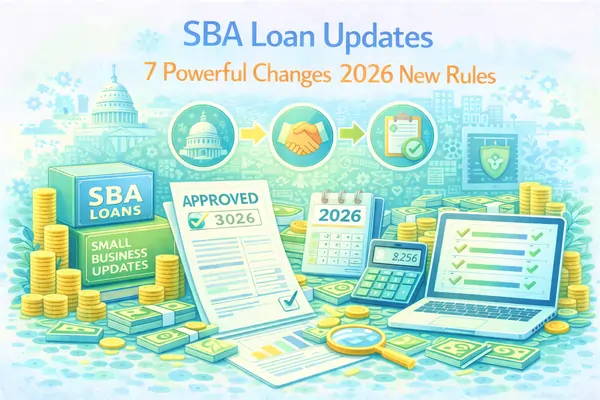
This comprehensive guide explores the most important SBA Loan Updates for 2026. We will analyze seven powerful changes, explain how they impact borrowers, break down eligibility revisions, review rate considerations, and provide strategic insights for maximizing approval success.
Understanding the SBA Loan Framework
Before analyzing recent SBA Loan Updates, it is important to understand how SBA programs function.
The SBA does not directly lend money in most cases. Instead, it guarantees a percentage of loans issued by approved lenders. This guarantee reduces lender risk and increases access to capital for small businesses that might not otherwise qualify under conventional standards.
The primary SBA loan programs include:
- 7(a) Loan Program
- CDC/504 Loan Program
- SBA Microloan Program
- SBA Express Loans
- Community Advantage Loans
Each program serves a specific business purpose. SBA Loan Updates often affect one or more of these categories differently.
7(a) Loan Program
The 7(a) loan is the SBA’s flagship product. It supports:
- Working capital
- Equipment purchases
- Real estate acquisition
- Business expansion
- Debt refinancing
Recent SBA Loan Updates have introduced refinements in underwriting standards and lender authority within this program.
CDC/504 Loan Program
The 504 program focuses primarily on fixed assets such as:
- Commercial real estate
- Heavy equipment
- Facility modernization
Certain SBA Loan Updates have clarified appraisal and valuation requirements for 504 financing.
Microloan Program
Microloans are smaller loans designed to support startups and underserved communities. Updated reporting requirements and intermediary guidelines are part of recent SBA Loan Updates affecting this segment.
Understanding these core programs creates context for evaluating the most impactful changes.
1. Expanded Lender Participation and Oversight Reform
One of the most significant SBA Loan Updates in 2026 involves changes to lender participation rules.
Increased Non-Bank Lender Access
The SBA has broadened eligibility for certain non-bank financial institutions to participate in SBA-backed programs. This expansion aims to:
- Increase capital access in underserved markets
- Accelerate approval timelines
- Encourage fintech integration
These SBA Loan Updates improve competition among lenders, potentially benefiting borrowers through improved service and faster processing.
Enhanced Risk Monitoring
At the same time, oversight standards have tightened. Enhanced lender reporting and compliance requirements are part of recent SBA Loan Updates designed to reduce fraud risk and ensure portfolio stability.
For borrowers, this means greater documentation accuracy and transparency are essential.
2. Adjustments to Eligibility Criteria
Eligibility standards have been clarified in recent SBA Loan Updates.
Ownership Structure Clarifications
Updated guidance defines:
- Eligible ownership percentages
- Foreign ownership thresholds
- Affiliation rule interpretations
Businesses with complex ownership structures should review these SBA Loan Updates carefully to confirm compliance.
Credit History Evaluation
While SBA loans remain accessible to businesses with moderate credit challenges, recent SBA Loan Updates emphasize:
- Payment history consistency
- Reduced tolerance for unresolved delinquencies
- Stronger emphasis on cash flow coverage ratios
These changes encourage responsible borrowing behavior while maintaining access to capital.
3. Interest Rate and Fee Modifications
Interest rate adjustments are among the most closely watched SBA Loan Updates.
Variable Rate Caps
Most SBA 7(a) loans use variable interest rates tied to benchmark indices. Updated SBA Loan Updates clarify:
- Maximum allowable spreads
- Benchmark calculation methodologies
- Rate adjustment timelines
Borrowers must evaluate long-term rate exposure carefully in a fluctuating interest environment.
Guarantee Fee Adjustments
Certain borrower segments benefit from:
- Reduced guarantee fees for smaller loans
- Incentives for underserved markets
- Temporary fee waivers in designated programs
These SBA Loan Updates may reduce overall borrowing costs for qualifying applicants.
4. Digital Modernization and Processing Improvements
Technology transformation is central to recent SBA Loan Updates.
Enhanced Online Application Systems
Updated platforms allow:
- Digital submission of financial statements
- Integrated tax transcript retrieval
- Real-time status tracking
These SBA Loan Updates streamline communication between borrowers and lenders.
Faster Underwriting Tools
Data integration tools enable lenders to analyze:
- Cash flow projections
- Industry risk benchmarks
- Credit bureau reports
Improved technology reduces processing time and improves transparency.
5. Strengthened Fraud Prevention Measures
In response to previous economic stimulus misuse, SBA Loan Updates have reinforced fraud prevention systems.
Identity Verification Enhancements
Applicants may face:
- Multi-layer identity authentication
- Cross-agency data validation
- Business registration verification
These SBA Loan protects program integrity but require careful documentation preparation.
Increased Audit Activity
Lenders are subject to:
- More frequent compliance reviews
- Stricter documentation retention standards
- Enhanced due diligence checks
Borrowers must maintain complete financial records to align with these SBA Loan.
6. Emphasis on Cash Flow Sustainability
SBA Loan Updates increasingly prioritize repayment capacity.
Debt Service Coverage Ratio (DSCR)
Lenders emphasize:
- Stable cash flow history
- Realistic revenue projections
- Conservative expense forecasting
Applicants must demonstrate sufficient DSCR to qualify under revised SBA Loan.
Reduced Reliance on Collateral Alone
While collateral remains important, updated loan updates highlight cash flow viability over asset valuation alone.
7. Targeted Support for Underserved Communities
Several SBA Loan Updates focus on inclusion.
Expanded Community Advantage Program
The Community Advantage program continues to support:
- Minority-owned businesses
- Women-owned enterprises
- Rural businesses
These SBA Loans Updates promote equitable capital distribution.
Technical Assistance Integration
Programs increasingly pair loans with:
- Business counseling
- Financial literacy training
- Mentorship support
This integration improves long-term repayment outcomes.
How SBA Loan Updates Affect Borrowers in 2026
Understanding loan updates allows entrepreneurs to prepare strategically.
Application Preparation
Applicants should:
- Update financial statements
- Review ownership documentation
- Improve credit consistency
- Strengthen cash flow projections
These actions align with recent SBA Loan Updates emphasizing transparency.
Rate Risk Planning
Given variable rate exposure, borrowers should:
- Model repayment scenarios
- Consider partial refinancing options
- Monitor benchmark rate movements
Proactive rate planning mitigates risk.
Compliance Awareness
Staying informed about SBA Loans reduces risk of documentation delays or approval setbacks.
Comparing SBA Loan Updates to Conventional Lending
While SBA loans remain attractive, businesses must compare options.
Advantages of SBA Programs
- Lower down payments
- Longer repayment terms
- Government-backed guarantees
- Competitive rates relative to unsecured lending
Considerations
- Extensive documentation requirements
- Processing timelines
- Compliance oversight
SBA Loans Updates aim to improve efficiency while preserving safeguards.
Long-Term Outlook for SBA Loan Updates
Looking ahead, additional SBA Loans updates may include:
- Expanded fintech partnerships
- Greater automation in underwriting
- ESG-related lending incentives
- Data-driven risk modeling enhancements
The SBA continues evolving in response to market conditions.
Key Takeaways
SBA Loan Updates in 2026 introduce expanded lender participation.
Eligibility standards emphasize cash flow sustainability.
Interest rate caps and fee structures have evolved.
Digital modernization improves processing speed.
Fraud prevention measures are stricter.
Underserved communities receive targeted support.
Variable rate exposure requires strategic planning.
Documentation accuracy is critical for approval.
Government guarantees still reduce lender risk.
Staying informed enhances funding success.
Frequently Asked Questions
What are SBA Loan Updates in 2026?
SBA Loan refers to recent changes in eligibility rules, interest rate caps, lender participation guidelines, and compliance standards affecting SBA-backed loan programs.
Do SBA Loan Updates make loans harder to qualify for?
Qualification standards emphasize cash flow sustainability, but expanded lender participation may improve access for qualified borrowers.
Have SBA interest rates changed?
Recent SBA Loans clarifies benchmark rate caps and allowable spreads, which may affect overall borrowing cost.
Are guarantee fees reduced?
Some borrower categories benefit from reduced or waived fees under specific SBA Loan Updates.
How long does SBA loan approval take now?
Digital modernization efforts have improved processing efficiency, but timelines vary by lender and documentation completeness.
Do SBA Loan Updates affect startups?
Startups may still qualify, particularly under microloan or Community Advantage programs, though strong projections are required.
Are personal guarantees still required?
In many cases, personal guarantees remain standard, though exact requirements depend on loan structure.
What documentation is most important?
Financial statements, tax returns, ownership details, and cash flow projections are critical under recent SBA Loan Updates.
Can existing borrowers refinance under new rules?
Refinancing may be possible depending on lender terms and eligibility under updated guidelines.
Why should business owners monitor SBA Loan Updates?
Because program adjustments affect approval criteria, cost structure, and strategic borrowing decisions.

Mary Gay Apud is an SEO Strategist, Educator, and Research Consultant specializing in structured, data-driven organic growth systems. With a strong foundation in Mathematics, she applies analytical precision, research methodology, and strategic thinking to build scalable SEO frameworks that enhance search visibility and long-term authority.
Her expertise includes content optimization, keyword strategy, technical SEO, and topical authority development—aligning performance with measurable business outcomes. With experience in team leadership, statistical consulting, and government service, Mary Gay combines discipline, accuracy, and structured execution in every project. She believes sustainable digital success is built on research, clarity, and long-term strategic implementation—not short-term trends.