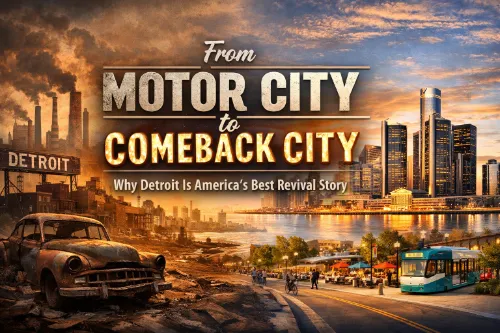
Detroit has gone from global symbol of decline to one of America’s comeback city success stories in just a decade. Once defined only as the Motor City, it now stands as America’s best revival story and a serious contender for the best city revival in the US.
This destination guide walks you through the Detroit comeback story—from factories and bankruptcy to murals, food halls, and riverfront parks—and shows you how to experience this Detroit revival story on your next trip.
Detroit’s Past: The Original Motor City
Detroit’s rise began with the automobile. Ford, General Motors, and Chrysler turned the city into the Motor City, attracting workers from across America and beyond. Massive plants, booming neighborhoods, and a strong middle class defined the early 20th century here.
At the same time, Motown Records was born on West Grand Boulevard, shaping global music and giving Detroit a second identity as a cultural powerhouse. You can still feel that history at the Motown Museum, where visitors stand inside the original recording studio.
This industrial might and artistic output created the foundation for today’s Detroit renaissance story, where history and reinvention meet on almost every block.
From Boomtown to Rock Bottom
By the 1970s and 1980s, the picture changed. Deindustrialization, suburban flight, and economic shocks led to plant closures, unemployment, and population loss. Large sections of the city were left with vacant homes and crumbling factories.
In 2013, the city’s financial crisis culminated in the largest municipal bankruptcy in U.S. history. This post‑bankruptcy Detroit recovery period was marked by headlines about decay and abandonment. To many outsiders, Detroit became a shorthand for urban failure, rather than for urban revival in America.
Yet even at that low point, community groups, local entrepreneurs, and artists were already working at street level, planting the seeds of city rebirth that would later fuel the Detroit revival story.
Seeds of Revival: How the Comeback Started
Detroit’s comeback did not happen overnight or by accident. It grew from a mix of major investment, small‑scale entrepreneurship, and community effort that together drove the economic revival in Detroit.
Key pieces of the puzzle include:
- Public–private partnerships focused on downtown and neighborhood corridors.
- Major companies reinvesting in the city, especially in mobility, finance, and tech.
- Local entrepreneurs opening cafés, bars, shops, and galleries that anchor revitalized neighborhoods in Detroit.
- Grassroots organizations tackling blight, supporting residents, and nurturing a new sense of pride.
This combination of top‑down and bottom‑up energy is a big reason why the Detroit revitalization success story stands out among any other American city comeback.
For a deeper civic and economic perspective, you can read Detroit’s story in the World Economic Forum’s analysis of the city’s revival.
Downtown Detroit Transformation
If you want to see the Detroit comeback city up close, start downtown. The downtown Detroit transformation is obvious the moment you step onto Woodward Avenue.
Historic skyscrapers now house hotels, apartments, and creative offices, backed by billions in private investment. Once‑empty storefronts host restaurants, coffee shops, and boutiques.
Public spaces—like Campus Martius Park, Spirit Plaza, and the Detroit International RiverWalk—are full of people relaxing, working, or attending events.
Here’s what to look for:
- Renovated landmarks that showcase city rebirth through adaptive reuse, such as the transformed Book Tower and the restored Michigan Central Station.
- Street‑level retail and dining that signal the economic revival in Detroit.
- Year‑round programming in parks and plazas that reflect modern urban renewal priorities: walkability, community, and culture.
This visible shift from empty to active is central to the Detroit revival story and one reason many travelers now call it America’s best revival story in real time.
For current events and openings, check the official tourism site at Visit Detroit.
Midtown and the Cultural Revival in Detroit
Just north of downtown, Midtown is the cultural heart of the Detroit renaissance story. It brings together museums, universities, hospitals, and nightlife in a compact, walkable area.
Midtown showcases the cultural revival in Detroit through:
- Major cultural institutions like the Detroit Institute of Arts, home to Diego Rivera’s famous Detroit Industry Murals.
- Galleries, performance spaces, and music venues fueling a creative boom.
- Side streets filled with cafés, breweries, and independent shops that anchor revitalized neighborhoods in Detroit.
Walking here, you can feel the city’s Detroit comeback story at street level—students, artists, professionals, and long‑time residents sharing the same parks, bike lanes, and businesses.
For a first‑timer‑friendly walk‑through, see guides like “First Time in Detroit: How to Plan the Perfect Trip”.
From Decline to Revival: Why Detroit’s Story Stands Out
Many cities have gone from decline to revival, but Detroit’s path is unusually dramatic. It went from being written off during bankruptcy to being held up as a textbook example of urban revival in America.
What makes this Detroit comeback story different?
- The depth of the fall: Few cities experienced such visible abandonment and financial crisis.
- The scale of change: Entire districts shifted from empty to active within a decade, driving a genuine Detroit tourism comeback.
- The role of residents: Long‑time Detroiters, not just outside investors, are central to the Detroit revival story and Detroit revitalization success.
This mix of hardship, creativity, and resilience is why so many observers now call Detroit America’s comeback city and see it as a living lesson in urban renewal.
Detroit as a Destination: What to Expect Now
Arriving in Detroit today, many visitors are surprised by how different reality feels from their expectations. Instead of a ghost town, they find a city buzzing with construction cranes, new businesses, and colorful murals.
The Detroit tourism comeback is built on:
- A food and drink scene that ranges from long‑standing classics to modern, chef‑driven spots.
- A music and arts culture that keeps the cultural revival in Detroit front and center.
- Walkable, bike‑friendly districts that highlight revitalized neighborhoods in Detroit and smart urban renewal.
It’s this contrast—between past headlines and present experience—that makes exploring Detroit feel like stepping into America’s best revival story.
For an overview of top sights, see the Tripadvisor list of best things to do in Detroit.
Key Experiences: How to Feel the Comeback
To really understand the Detroit comeback city energy, structure your visit around a few core themes.
1. Heritage and Industrial Roots
- Dive into automotive history at sites like the Henry Ford experience in nearby Dearborn and the Ford Piquette Avenue Plant, where early Model Ts were built. These spaces show where the Motor City story began.
- Visit industrial areas that now host events, offices, or creative spaces, symbolizing city rebirth and Detroit revitalization success.
2. Art, Murals, and Music
- Walk or bike in districts known for murals and street art, including community projects highlighted by outlets like National Geographic’s look at Detroit’s cool factor, to immerse yourself in the cultural revival in Detroit.
- Catch live music at historic venues and jazz clubs featured in itineraries from AFAR and others, continuing the city’s long tradition of innovation in sound and culture.
3. Food, Coffee, and Nightlife
- Sample classic local dishes and newer, globally inspired menus that reflect the economic revival in Detroit, from coney dogs to creative tasting menus.
- Spend your evenings in bars and venues that anchor revitalized neighborhoods in Detroit and attract both locals and visitors.
4. Parks, Riverfront, and Community Spaces
- Stroll the Detroit International RiverWalk and Belle Isle Park, highlighted in many travel guides, which are central to Detroit’s urban renewal strategy.
- Join public events, markets, or seasonal festivals that show the Detroit tourism comeback in motion.
Every one of these experiences gives you another angle on the Detroit revival story and why this feels like one of the most compelling American city comeback journeys anywhere.
Economic Revival in Detroit
Behind the visible changes in streets and skylines lies the broader economic revival in Detroit. The city has started to diversify beyond its traditional auto base into tech, mobility, finance, and creative industries.
This shift is crucial to the long‑term Detroit comeback story:
- New employers and startups are creating jobs and drawing talent back into the city.
- Renovation and construction work support the downtown Detroit transformation and revitalized neighborhoods in Detroit.
- Independent businesses—from cafés to studios—form the backbone of everyday Detroit revitalization success.
Together, these changes show that post‑bankruptcy Detroit recovery is more than a PR slogan. It is a structural urban renewal that underpins the claim that Detroit is America’s comeback city.
For more on the policy and investment side, see long‑form pieces like The New York Times’ report on Detroit’s economic rebound.
Challenges That Still Exist
A 10/10 honest guide acknowledges the full picture. Despite the powerful Detroit comeback story, serious challenges remain.
Not all areas have experienced the Detroit tourism comeback or economic revival in Detroit. Some neighborhoods still struggle with vacancy, disinvestment, and limited access to opportunity. Questions of affordability, equity, and inclusion are central to how this city rebirth continues.
Recognizing these issues doesn’t weaken the Detroit revival story; it makes it more real. Detroit’s journey from decline to revival is ongoing, and how the city handles these challenges will shape the next chapter of America’s best revival story.
Why Detroit Is America’s Best Revival Story
When you take everything together—the deep decline, the creative resurgence, the visible downtown Detroit transformation, the cultural revival in Detroit, and the economic revival in Detroit—it’s easy to see why many people call Detroit America’s best revival story.
It stands out because:
- The scale of change is impossible to miss in person.
- The Detroit renaissance story is driven by both big investment and neighborhood‑level passion.
- The identity shift—from “ruined Motor City” to Detroit comeback city—has happened within a single generation.
For other places seeking urban revival in America, Detroit has become a reference point, a real‑world example of an American city comeback that is still evolving.
Practical Detroit Destination Guide
To experience the Detroit revival story for yourself, use this simple, skimmable itinerary framework, then cross‑check with detailed guides from US News’ Detroit travel guide or 36 Hours in Detroit by The New York Times.
Best Time to Visit
- Spring and fall offer comfortable weather for walking tours of revitalized neighborhoods in Detroit and riverfront paths.
- Summer is peak season for festivals, outdoor events, and the most visible Detroit tourism comeback energy.
How Long to Stay
- Plan at least 2–3 days to see downtown, Midtown, and a couple of neighborhoods. That’s enough time to feel the Detroit comeback story beyond the headlines.
- Stay longer if you want to dig deeper into museums, architecture, and local events tied to the cultural revival in Detroit.
Sample 3‑Day Itinerary
Day 1: Downtown and Riverfront
- Explore the downtown Detroit transformation on foot, stopping at key landmarks, public plazas, and the Detroit International RiverWalk.
- Have dinner and drinks nearby to experience night‑time city rebirth and Detroit revitalization success in action.
Day 2: Midtown and Culture
- Spend the day in Midtown’s cultural district, visiting the Detroit Institute of Arts and nearby attractions featured in many “best things to do” lists.
- In the evening, see live music or a show that reflects the ongoing cultural revival in Detroit.
Day 3: Neighborhood Life and Local Businesses
- Choose one or two revitalized neighborhoods in Detroit, such as Corktown or Eastern Market, and visit markets, coffee shops, and independent stores.
- Talk with locals, hear their perspectives on post‑bankruptcy Detroit recovery, and see how everyday life fits into the broader Detroit comeback story.
Quick Q&A for Travel Search
Is Detroit worth visiting now?
Yes. Thanks to the Detroit tourism comeback, visitors find a blend of historic architecture, vibrant arts, evolving food and drink, and visible urban renewal that make the city a compelling stop.
Is Detroit safe to visit?
Like any big city, some areas are safer and more visitor‑friendly than others, but popular districts that showcase the Detroit revival story—such as downtown and key cultural areas—are actively managed and patrolled, especially around attractions, hotels, and major venues.
Why is Detroit called a comeback city?
Detroit earned the America’s comeback city nickname because it went from decline to revival after bankruptcy, with a visible downtown Detroit transformation, economic revival in Detroit, and cultural revival in Detroit that together form a powerful Detroit renaissance story.

I’m John Michael Palmes, an SEO practitioner with over three years of hands-on experience in search engine optimization and digital marketing. I help websites improve visibility, build effective SEO content strategies, and rank better on Google using practical, data-driven approaches.
My focus is on on-page SEO, keyword research, and content optimization—the fundamentals that help both search engines and users understand a site clearly. I continuously test, analyze results, and refine strategies, sharing honest and actionable SEO insights as search algorithms evolve.