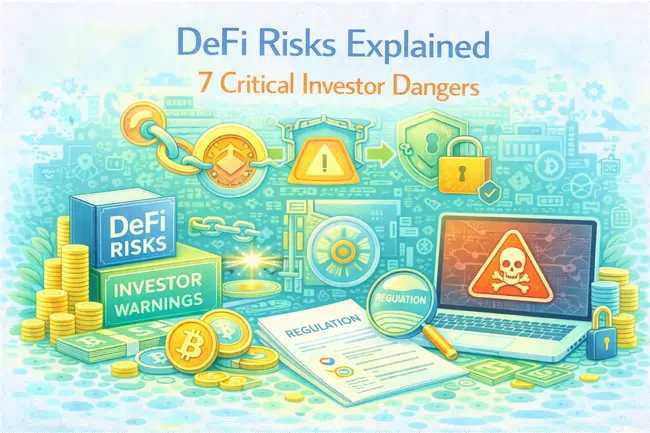
Why DeFi Risks Explained Matters in 2026
Decentralized Finance has transformed how investors interact with capital markets. What began as experimental blockchain protocols has evolved into a vast ecosystem of lending platforms, decentralized exchanges, staking protocols, yield aggregators, derivatives markets, and synthetic asset platforms.
With billions of dollars locked in smart contracts and increasing institutional interest, DeFi is no longer a fringe innovation.
Yet while the upside attracts attention, the downside often receives far less scrutiny. That is precisely why DeFi Risks Explained is essential reading for investors, founders, fintech professionals, and regulators in 2026.
Unlike traditional finance, DeFi operates without centralized intermediaries. There are no banks approving transactions, no regulators monitoring every trade in real time, and no customer support desk reversing mistaken transfers.
Code replaces institutions. Algorithms replace intermediaries. Smart contracts replace trust.
That innovation brings efficiency and openness. It also introduces new categories of risk.
DeFi Risks Explained is not about discouraging participation. It is about understanding exposure. In 2026, regulatory shifts, rising cybersecurity threats, smart contract exploits, liquidity instability, and governance vulnerabilities make risk awareness a strategic necessity.
This comprehensive guide on DeFi Risks Explained examines seven critical investor dangers, how they manifest, and how participants can mitigate them responsibly.
Understanding the Foundations of DeFi
Before analyzing DeFi Risks Explained in depth, it is important to understand what makes decentralized finance structurally different.
What Is DeFi?
Decentralized Finance refers to blockchain-based financial applications that operate through smart contracts without centralized intermediaries. These applications enable:
- Lending and borrowing
- Decentralized trading
- Liquidity provision
- Yield farming
- Staking
- Synthetic asset creation
- Cross-chain bridging
Protocols typically run on public blockchains such as Ethereum and other smart contract platforms.
Core Characteristics That Create Risk
DeFi Risks Explained begins with recognizing structural characteristics:
- Permissionless access
- Irreversible transactions
- Algorithmic execution
- Publicly visible code
- Anonymous or pseudonymous participation
- Token-based governance
These characteristics enhance innovation. They also amplify vulnerabilities.
1. Smart Contract Vulnerabilities
One of the most significant elements in DeFi Risks Explained is smart contract risk.
Code Is Law — Until It Fails
Smart contracts are self-executing programs deployed on blockchains. Once deployed, they often cannot be altered easily. If code contains a flaw, attackers may exploit it.
Common vulnerabilities include:
- Reentrancy attacks
- Integer overflow/underflow
- Logic errors in token minting
- Improper access control
- Oracle manipulation
Because DeFi protocols manage real capital, even small coding mistakes can result in multi-million-dollar losses.
Audit Limitations
While audits reduce risk, they do not eliminate it. Auditors:
- Review code at a specific moment in time
- May miss complex exploit paths
- Cannot guarantee zero vulnerability
DeFi Risks Explained must emphasize that “audited” does not mean “risk-free.”
Mitigation Strategies
Investors can reduce exposure by:
- Reviewing audit reports directly
- Diversifying across protocols
- Avoiding newly launched unaudited platforms
- Monitoring developer reputation
Understanding technical risk is central to DeFi Risks Explained.
2. Liquidity Risk and Market Volatility
Liquidity risk plays a crucial role in DeFi Risks Explained.
Automated Market Maker Dynamics
Many DeFi exchanges rely on Automated Market Makers (AMMs). Prices adjust based on liquidity pool ratios rather than centralized order books.
This model introduces:
- Slippage during large trades
- Price volatility in low-liquidity pools
- Impermanent loss for liquidity providers
Impermanent Loss Explained
Impermanent loss occurs when:
- Token prices diverge significantly
- Liquidity providers earn trading fees
- But underlying asset value shifts negatively
Investors may earn yield yet still experience net capital loss.
Liquidity Withdrawal Cascades
If users rapidly withdraw funds during volatility, liquidity pools may destabilize. This can:
- Exacerbate price swings
- Trigger liquidation events
- Reduce borrowing capacity
Liquidity instability is a foundational pillar of DeFi Risks Explained.
3. Regulatory and Legal Uncertainty
DeFi operates in a rapidly evolving regulatory environment.
Jurisdictional Ambiguity
Because DeFi protocols are decentralized:
- No single geographic operator may exist
- Governance tokens distribute decision-making
- Developers may remain pseudonymous
This complicates regulatory enforcement.
Enforcement Risk
Governments increasingly scrutinize:
- Token issuers
- Governance structures
- Front-end interfaces
- Stablecoin integrations
Sudden enforcement actions can:
- Restrict access to platforms
- Freeze assets
- Reduce liquidity
DeFi Risks Explained must address that regulatory clarity remains uneven across jurisdictions.
Investor Impact
Regulatory changes may affect:
- Token classification
- Tax reporting requirements
- KYC expectations
- Stablecoin reserves
Proactive monitoring of policy developments reduces exposure.
4. Oracle Manipulation and Data Integrity Risk
Many DeFi protocols rely on oracles — systems that feed external data into blockchain smart contracts.
Why Oracles Matter
Oracles supply critical data such as:
- Asset prices
- Interest rates
- Collateral valuations
If oracle feeds are compromised, protocols may execute faulty logic.
Oracle Attack Vectors
Attackers may:
- Manipulate low-liquidity markets
- Temporarily inflate asset prices
- Trigger undercollateralized borrowing
- Extract value through flash loans
Because smart contracts rely on external data, compromised feeds can cascade across ecosystems.
DeFi Risks Explained must include oracle vulnerability as a systemic risk.
Risk Mitigation
Investors should evaluate:
- Oracle decentralization
- Data aggregation models
- Protocol reliance on single data sources
Robust oracle design reduces systemic fragility.
5. Governance and DAO Vulnerabilities
Governance tokens enable decentralized decision-making. However, DeFi Risks Explained highlights that governance itself introduces exposure.
Token Concentration
If a small group controls majority governance tokens, they may:
- Alter protocol parameters
- Redirect treasury funds
- Change fee structures
- Approve harmful proposals
Decentralization can become illusionary.
Low Participation Risk
If voter turnout is low, governance decisions may not reflect broader community interests.
Malicious Proposal Attacks
Attackers may:
- Accumulate tokens temporarily
- Propose malicious changes
- Execute governance capture
DAO governance remains experimental. Governance risk is a critical part of DeFi Risks Explained.
6. Stablecoin and Peg Instability
Stablecoins serve as liquidity anchors within DeFi ecosystems.
Types of Stablecoins
- Fiat-backed stablecoins
- Algorithmic stablecoins
- Crypto-collateralized stablecoins
Each model carries distinct vulnerabilities.
Depegging Events
If confidence falters or collateral declines, stablecoins may lose their peg. This can:
- Trigger liquidation cascades
- Collapse lending positions
- Reduce liquidity across protocols
DeFi Risks Explained must include stablecoin systemic exposure.
Regulatory Pressure on Stablecoins
In 2026, stablecoin oversight has intensified. Regulatory shifts may impact:
- Reserve transparency
- Issuance restrictions
- Cross-border usability
Investors must evaluate reserve disclosures carefully.
7. Cybersecurity and Private Key Risk
Even if protocols function correctly, users face personal security risks.
Wallet Vulnerabilities
Common user risks include:
- Phishing attacks
- Malware infiltration
- Compromised private keys
- Social engineering scams
Unlike traditional banks, blockchain transactions are irreversible.
Bridge Exploits
Cross-chain bridges have become major attack targets. Vulnerabilities in bridging mechanisms can lead to:
- Massive capital drains
- Token devaluation
- Liquidity fragmentation
DeFi Risks Explained emphasizes that user-level security is as important as protocol security.
Risk Mitigation Strategies
Users should:
- Use hardware wallets
- Verify contract addresses
- Avoid suspicious links
- Enable multi-signature protections
Security hygiene significantly reduces exposure.
Systemic Risk in DeFi Ecosystems
Beyond individual protocol risk, DeFi Risks Explained must consider interconnected vulnerabilities.
Composability Risk
DeFi protocols are “composable,” meaning they integrate with one another. A failure in one protocol may affect others through:
- Shared collateral
- Interconnected lending pools
- Oracle dependencies
This interdependence increases systemic exposure.
Leverage Amplification
High leverage within DeFi ecosystems can:
- Magnify volatility
- Accelerate liquidation spirals
- Trigger cascading failures
Leverage risk remains underestimated in many investor strategies.
Psychological and Behavioral Risk
Technology risk is not the only concern in DeFi Risks Explained.
Yield Chasing Behavior
Investors may pursue unsustainable high yields without understanding:
- Underlying token inflation
- Liquidity mining dilution
- Reward sustainability
Short-term rewards may mask long-term structural weaknesses.
Herd Mentality
Rapid inflows into trending protocols increase vulnerability if sentiment reverses suddenly.
Behavioral discipline is essential.
How to Approach DeFi Responsibly
Understanding DeFi Risks Explained is only valuable if paired with action.
Diversification
Avoid concentrating capital in a single protocol or token.
Risk-Based Allocation
Allocate only a percentage of portfolio to high-risk DeFi assets.
Continuous Monitoring
Monitor:
- Governance proposals
- Audit updates
- Market volatility
- Regulatory developments
Understand Protocol Mechanics
Before investing, evaluate:
- Tokenomics
- Collateralization ratios
- Revenue models
- Developer track records
Education reduces exposure.
Long-Term Outlook for DeFi Risks Explained
DeFi innovation continues evolving. In the coming years, we may see:
- Formalized regulatory integration
- Insurance-backed protocols
- Improved audit automation
- Institutional custody partnerships
- On-chain transparency standards
However, risk will never disappear entirely.
DeFi Risks Explained in 2026 reflects a maturing ecosystem navigating innovation and oversight simultaneously.
Key Takeaways
DeFi Risks Explained highlights smart contract vulnerabilities as primary threats.
Liquidity instability can magnify losses.
Regulatory uncertainty remains significant.
Oracle manipulation can destabilize protocols.
Governance concentration increases control risk.
Stablecoin depegging creates systemic exposure.
User-level cybersecurity remains critical.
Composability increases interconnected risk.
Leverage amplifies volatility.
Disciplined allocation reduces exposure.
Frequently Asked Questions
What does DeFi Risks Explained mean?
DeFi Risks Explained refers to an analysis of the vulnerabilities, systemic threats, and investor dangers associated with decentralized finance platforms.
Are DeFi platforms safe in 2026?
Safety depends on protocol design, audits, governance structure, and user security practices. No platform is entirely risk-free.
What is impermanent loss?
Impermanent loss occurs when providing liquidity in automated market makers and token prices diverge significantly.
Can smart contract audits prevent hacks?
Audits reduce risk but cannot eliminate all vulnerabilities.
Are stablecoins risk-free?
No. Stablecoins can face depegging, reserve transparency, and regulatory challenges.
How does regulation affect DeFi?
Regulation may impact token classification, exchange access, KYC requirements, and stablecoin operations.
What is oracle manipulation?
It occurs when attackers exploit price feed systems to distort smart contract execution.
Is DeFi riskier than traditional finance?
DeFi introduces novel technical and governance risks not present in traditional systems.
How can investors reduce DeFi risk?
Through diversification, research, security best practices, and continuous monitoring.
Will DeFi become safer over time?
Technological improvements and regulatory clarity may reduce risk, but exposure will remain inherent in decentralized systems.

Mary Gay Apud is an SEO Strategist, Educator, and Research Consultant specializing in structured, data-driven organic growth systems. With a strong foundation in Mathematics, she applies analytical precision, research methodology, and strategic thinking to build scalable SEO frameworks that enhance search visibility and long-term authority.
Her expertise includes content optimization, keyword strategy, technical SEO, and topical authority development—aligning performance with measurable business outcomes. With experience in team leadership, statistical consulting, and government service, Mary Gay combines discipline, accuracy, and structured execution in every project. She believes sustainable digital success is built on research, clarity, and long-term strategic implementation—not short-term trends.