Introduction
Rising prices affect nearly every household. Groceries cost more, rent creeps upward, utilities fluctuate, and long-term savings quietly lose purchasing power.
In this environment, inflation-proof budgeting becomes not just a helpful tactic but a financial necessity.
Inflation reduces the value of money over time. If your income remains stable while expenses increase, the gap must be covered either by cutting spending, increasing earnings, or dipping into savings.
Without a structured plan, this erosion happens gradually and often goes unnoticed until financial stress appears.
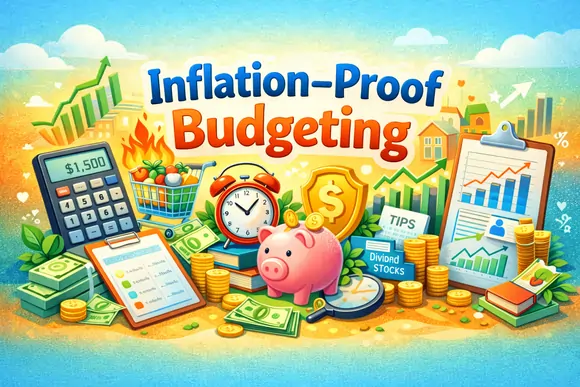
Inflation-proof budgeting is a strategic approach to managing money that anticipates rising costs. Instead of relying on rigid monthly numbers, it builds flexibility, resilience, and growth into your financial plan.
It protects purchasing power, safeguards savings, and supports long-term wealth building—even when economic conditions fluctuate.
This guide provides a comprehensive framework built on economic principles, behavioral finance insights, and practical real-world budgeting techniques.
By the end, you will understand how to design a budget that adapts to inflation, protects your financial stability, and strengthens your future.
Understanding Inflation and Its Financial Impact
Before implementing inflation-proof budgeting, it is essential to understand how inflation affects your finances.
Inflation represents the rate at which prices increase over time. Even moderate inflation, such as 3% annually, compounds significantly. Over ten years, purchasing power can decline noticeably. High inflation accelerates this effect.
How Inflation Impacts Households
- Reduced Purchasing Power
Money buys less than it did before. Essentials like food and fuel become more expensive, leaving less room for savings. - Rising Fixed Costs
Rent, mortgage adjustments, tuition, healthcare, and insurance premiums may increase annually. - Weaker Cash Savings
Funds held in low-interest accounts often fail to keep up with inflation, effectively losing value. - Increased Borrowing Costs
Interest rates often rise during inflationary periods, making debt more expensive.
Inflation-proof budgeting addresses these challenges by designing a system that absorbs cost increases while maintaining financial progress.
What Is Inflation-proof Budgeting?
Inflation-proof budgeting is a dynamic financial strategy designed to maintain purchasing power and financial stability in rising-cost environments.
It differs from traditional budgeting in three core ways:
- It emphasizes adaptability instead of fixed allocations.
- It prioritizes wealth-preserving assets over idle cash.
- It integrates income growth into financial planning.
Rather than simply tracking expenses, inflation-proof budgeting builds protective mechanisms into your financial life.
The Psychology Behind Financial Resilience
Inflation does not only affect numbers—it affects behavior. Fear-driven spending, panic-saving, or extreme cost-cutting often lead to burnout.
A sustainable inflation-proof budgeting approach requires:
- Clear financial priorities
- Emotional discipline
- Data-based decision-making
- Long-term thinking
When financial systems are structured properly, stress decreases and decision quality improves.
9 Smart Money Moves for Inflation-proof Budgeting
1. Shift to Percentage-Based Allocation
Fixed budgets fail during inflation because expense categories fluctuate unpredictably. Percentage-based budgeting scales naturally with income changes.
A typical model might include:
- 50% essentials
- 30% lifestyle
- 20% savings and investments
If income increases, savings increase automatically. If essential costs rise temporarily, adjustments remain proportional rather than disruptive.
This structure is foundational to inflation-proof budgeting because it maintains balance even when expenses fluctuate.
2. Strengthen Your Emergency Fund
Inflation increases uncertainty. A larger emergency fund provides protection against:
- Job instability
- Unexpected medical costs
- Rapid price spikes
- Economic downturns
Aim for six to nine months of essential expenses. Store funds in high-yield savings accounts to offset inflation partially.
An emergency fund acts as a stabilizer within inflation-proof budgeting, preventing debt reliance.
3. Reduce Subscription and Lifestyle Creep
Small recurring costs compound significantly over time.
Conduct a quarterly audit:
- Streaming platforms
- Memberships
- App subscriptions
- Automatic renewals
Evaluate whether each service adds measurable value. Eliminating unnecessary subscriptions strengthens liquidity and improves flexibility.
Inflation-proof budgeting requires vigilance against gradual expense expansion.
4. Automate Savings and Investments
Automation removes emotion from financial discipline.
Set automatic transfers for:
- Retirement accounts
- Index fund investments
- High-yield savings
- Debt payments
Automated systems prevent inflation-driven impulse spending and ensure consistency.
5. Diversify Into Inflation-Resistant Assets
Cash alone rarely outpaces inflation. Investment diversification protects long-term purchasing power.
Consider:
- Broad market index funds
- Dividend-paying stocks
- Real estate investments
- Treasury Inflation-Protected Securities
- Commodities exposure
Asset allocation depends on risk tolerance, but diversification is critical for inflation-proof budgeting success.
6. Increase Income Strategically
Cost-cutting alone has limits. Income growth creates financial elasticity.
Strategies include:
- Upskilling for higher-paying roles
- Freelancing or consulting
- Digital side businesses
- Passive income development
Inflation-proof budgeting integrates earning expansion into financial planning rather than relying solely on frugality.
7. Renegotiate Fixed Expenses
Many fixed costs are negotiable.
Examples:
- Insurance premiums
- Internet packages
- Phone plans
- Loan interest rates
Even minor reductions improve long-term cash flow.
8. Practice Strategic Bulk Buying
When inflation affects staple goods, bulk purchasing reduces long-term cost exposure.
Focus on:
- Non-perishable food
- Household supplies
- Personal care items
However, avoid overstocking perishables or accumulating unnecessary inventory.
9. Review and Adjust Quarterly
Economic conditions shift. Quarterly reviews ensure your inflation-proof budgeting strategy remains aligned with reality.
Evaluate:
- Spending increases
- Savings rates
- Investment performance
- Income growth
Adaptability strengthens financial resilience.
Advanced Strategies for Long-Term Protection
Inflation-Adjusted Savings Goals
Instead of static savings targets, adjust goals annually to reflect inflation rates. This ensures real progress rather than nominal growth.
Debt Management in Inflationary Periods
Inflation can reduce the real value of fixed-rate debt, but variable-rate debt becomes riskier. Prioritize paying off high-interest obligations.
Geographic Arbitrage
Remote work allows relocation to lower-cost areas. Reduced living expenses significantly enhance inflation-proof budgeting efficiency.
Building a Sustainable Budget Framework
A structured budgeting framework includes:
- Income clarity
- Expense categorization
- Savings automation
- Investment allocation
- Quarterly evaluation
When combined, these create a protective financial ecosystem.
Common Mistakes to Avoid
- Hoarding excessive cash
- Ignoring investment growth
- Failing to review budgets
- Emotional investing
- Over-cutting essentials
Balanced inflation-proof budgeting prioritizes sustainability over extremes.
Key Takeaways
- Inflation reduces purchasing power gradually but consistently.
- Inflation-proof budgeting emphasizes adaptability.
- Percentage-based allocations outperform rigid systems.
- Investment diversification is essential.
- Income growth strengthens financial resilience.
- Emergency funds provide stability.
- Quarterly reviews maintain relevance.
- Automation improves discipline.
- Negotiation reduces long-term cost burden.
- Sustainable systems outperform short-term reactions.

Frequently Asked Questions
What is inflation-proof budgeting?
Inflation-proof budgeting is a financial strategy that adapts income allocation, savings, and investments to protect purchasing power during rising costs.
How often should I review my budget during inflation?
Quarterly reviews are recommended to adjust for cost changes and income fluctuations.
Is investing necessary for inflation protection?
Investing helps preserve long-term purchasing power, especially when inflation exceeds savings account returns.
How much should I keep in emergency savings?
Six to nine months of essential expenses is ideal during uncertain economic periods.
Does inflation benefit borrowers?
Fixed-rate borrowers may benefit because inflation reduces the real value of debt over time.
Should I avoid all debt during inflation?
High-interest or variable-rate debt should be minimized. Strategic fixed-rate debt may be manageable.
How do I calculate inflation impact on my savings?
Compare your savings interest rate to current inflation rates to determine real returns.
Can budgeting apps help?
Yes. Digital tracking tools enhance accuracy and visibility, improving financial decision-making.
What investments resist inflation best?
Historically, diversified equities, real estate, and inflation-protected securities perform well.
Is inflation-proof budgeting realistic for low-income households?
Yes. Even small structural adjustments improve financial resilience over time.
Conclusion
Inflation brings uncertainty, but uncertainty does not have to control your financial future. The most resilient households are not those who react emotionally to rising prices, but those who build systems that adapt, protect, and grow over time. By strengthening savings, diversifying investments, increasing income potential, and reviewing expenses regularly, you create a financial structure that can absorb economic pressure without collapsing under it.
True stability comes from proactive planning, not short-term reactions. When your money strategy is flexible, data-driven, and aligned with long-term goals, you reduce stress and increase confidence—regardless of what the economy is doing. Inflation-proof budgeting empowers you to stay ahead of rising costs, preserve purchasing power, and continue building wealth with clarity and control.

Mary Gay Apud is an SEO Strategist, Educator, and Research Consultant specializing in structured, data-driven organic growth systems. With a strong foundation in Mathematics, she applies analytical precision, research methodology, and strategic thinking to build scalable SEO frameworks that enhance search visibility and long-term authority.
Her expertise includes content optimization, keyword strategy, technical SEO, and topical authority development—aligning performance with measurable business outcomes. With experience in team leadership, statistical consulting, and government service, Mary Gay combines discipline, accuracy, and structured execution in every project. She believes sustainable digital success is built on research, clarity, and long-term strategic implementation—not short-term trends.