Introduction
The financial industry is undergoing one of the most profound transformations in its history. Digitalization, regulatory evolution, cybersecurity threats, and changing customer expectations have forced banks to rethink traditional models.
At the center of this shift stands AI in banking, a technological advancement that is not merely automating tasks but redefining how financial institutions operate, compete, and deliver value.
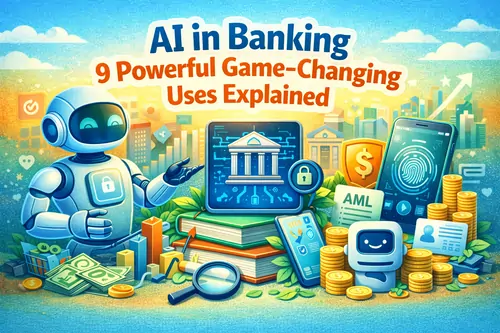
Artificial intelligence is no longer experimental within financial services. AI in banking now powers fraud detection systems, personalizes digital banking experiences, optimizes credit decisions, enhances risk modeling, and supports regulatory compliance.
What once required hours of manual review can now be processed in seconds with improved accuracy.
Yet the rise of intelligent systems in finance is not just about efficiency. It is about intelligence-driven decision-making, predictive insights, customer-centric innovation, and strategic scalability.
Banks that integrate artificial intelligence responsibly are strengthening security, reducing operational costs, and expanding access to financial services.
This comprehensive guide explores nine powerful, game-changing uses transforming modern finance. It examines technical foundations, strategic applications, ethical considerations, regulatory impacts, and long-term implications for institutions and consumers alike.
Understanding Artificial Intelligence in Financial Services
Before exploring practical applications, it is important to define what artificial intelligence means in a banking context.
Artificial intelligence refers to systems capable of performing tasks that traditionally require human intelligence. These tasks include learning from data, identifying patterns, making predictions, recognizing speech, and automating decision-making processes.
Within financial institutions, AI-driven systems typically rely on:
- Machine Learning Models
Algorithms trained on large datasets to identify patterns and improve predictions over time. These systems refine themselves as new financial data becomes available. - Natural Language Processing (NLP)
Technology enabling machines to understand and respond to human language. This is commonly used in chatbots, document analysis, and sentiment tracking. - Robotic Process Automation (RPA)
Tools designed to automate repetitive tasks such as data entry, reconciliation, and compliance reporting. - Predictive Analytics
Data modeling techniques used to forecast trends, detect anomalies, and guide strategic decisions.
When integrated effectively, AI in banking enhances precision, speed, scalability, and risk management.
Why Artificial Intelligence Is Reshaping Modern Banking
Financial institutions manage massive volumes of structured and unstructured data. Every transaction, customer interaction, credit application, and compliance review generates valuable information. Traditional systems struggle to process this data efficiently.
AI-driven infrastructure allows banks to:
- Analyze millions of transactions in real time
- Detect fraud patterns instantly
- Personalize financial advice dynamically
- Predict credit risk more accurately
- Automate regulatory compliance checks
The ability to turn raw data into actionable insight gives banks a strategic competitive advantage.
9 Powerful Game-Changing Uses
Intelligent Fraud Detection
Fraud prevention is one of the most impactful applications of AI in banking. Traditional rule-based systems rely on predefined triggers. However, fraud patterns evolve constantly, making static systems vulnerable.
Modern AI models detect anomalies by analyzing:
- Transaction timing patterns
- Spending behavior deviations
- Geolocation inconsistencies
- Device fingerprinting data
- Historical fraud signatures
Instead of simply flagging large transactions, AI-driven systems assess contextual behavior. For example, if a customer regularly travels internationally, overseas purchases may not trigger alerts. This reduces false positives and improves customer satisfaction.
The result is faster fraud detection, lower financial losses, and enhanced trust.
Personalized Customer Experience
Customer expectations have shifted dramatically. Users now expect seamless digital interactions similar to streaming platforms and e-commerce services.
AI in banking enables hyper-personalization by:
- Analyzing transaction history
- Monitoring financial goals
- Predicting spending habits
- Recommending savings strategies
- Offering tailored loan products
Digital assistants can provide customized insights such as suggesting better credit card options or alerting users to subscription renewals.
Personalized engagement strengthens retention and builds long-term loyalty.
Advanced Credit Scoring and Lending Decisions
Traditional credit scoring relies heavily on limited data points such as payment history and credit utilization. This approach often excludes individuals with thin credit files.
AI-powered credit evaluation systems incorporate broader datasets, including:
- Utility payments
- Rental history
- Income consistency
- Behavioral financial indicators
This expanded assessment model increases financial inclusion while reducing default risk.
Banks benefit from more accurate risk modeling, while consumers gain access to credit opportunities previously unavailable.
Regulatory Compliance Automation
Regulatory compliance remains one of the most resource-intensive areas of banking.
AI systems assist compliance teams by:
- Monitoring transactions for suspicious activities
- Flagging anti-money laundering (AML) risks
- Automating Know Your Customer (KYC) verification
- Reviewing documentation for policy adherence
Instead of manually reviewing thousands of transactions, compliance officers can focus on high-risk cases identified by AI in banking intelligent systems.
This improves accuracy while reducing operational costs.
Predictive Risk Management
Risk management is central to financial stability.
AI enhances predictive modeling by analyzing:
- Market volatility indicators
- Credit portfolio exposure
- Macroeconomic data
- Customer behavior trends
Predictive analytics allows banks to anticipate liquidity issues, adjust lending strategies, and prepare for economic downturns.
Proactive risk mitigation strengthens institutional resilience.
Chatbots and Virtual Assistants
Customer service automation has evolved significantly.
AI-powered chatbots can:
- Answer frequently asked questions
- Guide customers through account setup
- Process simple transactions
- Escalate complex issues to human representatives
Natural language processing ensures responses feel conversational rather than robotic.
This reduces wait times and lowers service costs while maintaining availability 24/7.
Investment Advisory and Wealth Management
Robo-advisors use AI-driven algorithms to create diversified portfolios based on:
- Risk tolerance
- Investment horizon
- Income level
- Financial goals
These systems automatically rebalance portfolios as markets shift.
By lowering entry barriers, intelligent advisory tools democratize wealth management services.
Operational Efficiency and Cost Reduction
Back-office operations generate substantial administrative workload.
AI optimizes efficiency by:
- Automating loan processing
- Streamlining document verification
- Reducing manual reconciliation errors
- Enhancing treasury management
Operational automation frees human employees to focus on strategic decision-making.
Cybersecurity Enhancement
Financial institutions are prime targets for cyberattacks.
AI-powered cybersecurity systems monitor:
- Login behavior patterns
- Network anomalies
- Data access irregularities
- Malware signatures
Real-time threat detection prevents breaches before they escalate.
Cyber resilience is critical to sustaining trust in digital banking.
Ethical Considerations and Governance
While AI in banking offers transformative benefits, ethical considerations must be addressed.
Bias Mitigation
Machine learning models may unintentionally reflect biases present in historical data.
Banks must:
- Conduct fairness audits
- Diversify training datasets
- Monitor decision outcomes
- Implement transparent reporting
Responsible deployment ensures equitable treatment across demographic groups.
Data Privacy Protection
Financial data is highly sensitive.
Institutions must enforce:
- Encryption standards
- Secure cloud infrastructure
- Strict access controls
- Regulatory compliance frameworks
Customer trust depends on safeguarding personal information.
Transparency and Explainability
Complex algorithms can function as “black boxes.”
Explainable AI techniques help institutions:
- Clarify lending decisions
- Justify risk assessments
- Maintain regulatory transparency
Clear communication strengthens accountability.
Long-Term Impact on Employment
Automation changes workforce dynamics.
Rather than eliminating roles entirely, AI shifts responsibilities toward:
- Data analysis
- Strategic oversight
- Customer relationship management
- Model governance
Upskilling initiatives ensure employees adapt successfully.
Competitive Landscape and Future Outlook
Fintech startups leverage AI-native systems to compete with traditional banks.
To remain competitive, established institutions must:
- Invest in digital infrastructure
- Partner with technology providers
- Prioritize cybersecurity
- Maintain regulatory compliance
The future of banking will likely blend human expertise with intelligent automation.
Key Takeaways
- Artificial intelligence is transforming financial services at every operational level.
- Fraud detection systems are becoming more adaptive and precise.
- Personalized financial experiences improve customer loyalty.
- Credit assessment models are expanding financial inclusion.
- Compliance automation reduces regulatory risk.
- Predictive analytics enhances strategic planning.
- Cybersecurity defenses are increasingly AI-driven.
- Ethical governance remains essential.
- Workforce roles are evolving rather than disappearing.
- Long-term competitiveness depends on responsible innovation.

Frequently Asked Questions
What is AI in banking?
AI in banking refers to the use of intelligent algorithms and machine learning systems to automate processes, improve decision-making, and enhance customer experiences within financial institutions.
How does artificial intelligence improve fraud detection?
AI in banking analyzes transaction patterns in real time, identifying anomalies that traditional rule-based systems might overlook.
Is customer data safe with AI in banking systems?
Security depends on implementation. Banks must use encryption, regulatory compliance frameworks, and strict governance standards.
Can AI in banking replace human bankers?
While automation handles repetitive tasks, strategic and relationship-driven roles still require human expertise.
How does AI in banking impact lending decisions?
AI in banking improves accuracy by analyzing broader data sources, reducing default risk while increasing inclusion.
Are chatbots reliable for financial advice?
They are effective for routine inquiries but complex financial planning may still require professional consultation.
What are robo-advisors?
Automated investment platforms that create and manage portfolios based on user preferences and risk tolerance.
How does AI support regulatory compliance?
It monitors transactions, detects suspicious activity, and automates documentation review processes.
What risks come with AI adoption?
Potential risks include bias, data breaches, lack of transparency, and regulatory challenges.
What is the future of AI in banking?
Future developments will likely integrate advanced predictive analytics, enhanced cybersecurity systems, and more personalized digital financial services.
Conclusion
The financial landscape is evolving at a pace few industries have experienced before. Institutions that balance innovation with accountability will define the next era of financial services.
Success will not belong to those who simply adopt new technologies, but to those who integrate them thoughtfully—prioritizing security, transparency, regulatory compliance, and customer trust at every stage of implementation.
As digital ecosystems expand and customer expectations grow more sophisticated, financial organizations must remain agile, data-driven, and ethically grounded.
Strategic investment in intelligent systems, continuous workforce development, and responsible governance will separate industry leaders from those struggling to adapt.
Ultimately, AI in banking is not just a technological upgrade—it is a transformational force reshaping how money is managed, protected, and delivered in a rapidly advancing global economy.

Mary Gay Apud is an SEO Strategist, Educator, and Research Consultant specializing in structured, data-driven organic growth systems. With a strong foundation in Mathematics, she applies analytical precision, research methodology, and strategic thinking to build scalable SEO frameworks that enhance search visibility and long-term authority.
Her expertise includes content optimization, keyword strategy, technical SEO, and topical authority development—aligning performance with measurable business outcomes. With experience in team leadership, statistical consulting, and government service, Mary Gay combines discipline, accuracy, and structured execution in every project. She believes sustainable digital success is built on research, clarity, and long-term strategic implementation—not short-term trends.