
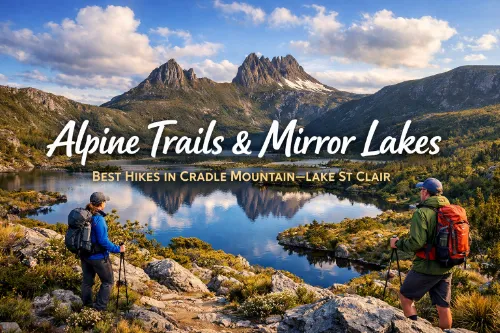
Tasmania’s Alpine Wonderland
Cradle Mountain–Lake St Clair National Park is one of Tasmania’s most iconic wilderness areas, famous for its alpine trails, crystal-clear alpine lakes, and dramatic dolerite peaks reflected in still, mirror-like water.
This guide focuses on the best hikes that combine high alpine scenery with serene lakeside trails, so you can experience both rugged summits and glassy mirror lakes in one trip.
You’ll find everything from easy lakeside walks around Dove Lake and Lake St Clair to more challenging alpine hiking routes like Marions Lookout, Crater Lake, and Mt Rufus.
Whether you’re a casual walker chasing scenic lakeside trails, a photographer obsessed with reflective mountain lakes, or a hiker looking for wilderness hiking adventures, this destination guide will help you plan your time in Tasmania’s high country.
Cradle Mountain–Lake St Clair at a Glance
- Location: Central Highlands, Tasmania, Australia, between Launceston and Hobart
- Driving time: Approx. 2.5 hours from Launceston to Cradle Mountain; around 4–5 hours from Hobart to Cradle Mountain or Lake St Clair
- Park type: World Heritage–listed alpine wilderness with glacial lakes and rugged peaks
- Best time for hiking: Late spring to early autumn (October–April) for clearer trails and more stable weather
- Best time for mirror-like lakes: Still mornings and evenings in summer and autumn
- Trail range: Easy lakeside walks to full-day alpine wilderness hikes and the multi-day Overland Track
- Ideal for: Hikers, landscape photographers, road‑trippers, and anyone who loves alpine lake hikes and wilderness scenery
Best Hikes in Cradle Mountain–Lake St Clair (Quick List)
- Dove Lake Circuit – Iconic mirror lake loop beneath Cradle Mountain, easy–moderate, about 6 km
- Crater Lake & Marions Lookout – Steep alpine trail to one of the park’s best viewpoints, moderate–challenging
- Cradle Mountain Summit – Scrambly alpine route with panoramic views, for experienced hikers only
- Lake St Clair Foreshore & Glacier Rock – Relaxed lakeside trails with serene mountain reflections
- Shadow Lake – Backcountry lake hike with quiet shores and alpine scenery, moderate
- Mt Rufus Circuit – Big day out with high‑alpine views over lakes and ranges, challenging
Essential Things to Know Before You Hike
Cradle Mountain–Lake St Clair National Park sits in Tasmania’s central highlands and is split into two main areas: the northern Cradle Mountain section and the southern Lake St Clair section. The park is part of the Tasmanian Wilderness World Heritage Area and is known for its cool, alpine climate and “four seasons in a day” weather, even in summer.
Access to popular walks like the Dove Lake Circuit is via a shuttle bus from the Cradle Mountain Visitor Centre for much of the year, which helps protect this fragile alpine environment by limiting private vehicles.
You’ll need a valid Tasmanian National Parks Pass; many visitors opt for a 72‑hour pass that covers a short stay. On the Lake St Clair side, trailheads are generally accessed by car via the Lake St Clair Visitor Centre and campground area on the lake’s shore.
Weather is a critical factor when planning alpine trails. Summer is usually the best time for hiking, with longer days and milder temperatures, although conditions can still be cold, wet, and windy.
Autumn brings clearer days and the famous turning of the fagus, when Tasmania’s only deciduous tree turns golden around the slopes above Dove Lake and Crater Lake.
Spring and winter often mean snow on the peaks and icy tracks, which can be beautiful but challenging, especially on exposed alpine routes like the Cradle Mountain summit or Mt Rufus.
Map Overview: Cradle vs Lake St Clair
The northern Cradle Mountain area centres around the Cradle Mountain Visitor Centre, Ronny Creek, and Dove Lake trailheads, which provide access to most of the classic day walks. This is where you’ll find the famous Cradle Mountain skyline rising above Dove Lake, with boardwalks leading to alpine lake hikes, subalpine forests, and moorland.
The southern Lake St Clair section is built around Cynthia Bay, on the shores of Lake St Clair, Australia’s deepest natural lake. Here you’ll find short lakeside walks, foreshore tracks, and longer day hikes like the Mt Rufus Circuit, which climbs to an exposed alpine summit with sweeping views over glacial lakes and distant ranges.
If you want to visit both ends, factor in the driving time between them. There are shuttle and transfer services linking Cradle Mountain with Lake St Clair, Launceston, and Hobart, which can be handy if you’re also walking all or part of the Overland Track.
For a first visit focused on alpine trails and mirror lakes, many travellers base themselves at Cradle Mountain for 2–3 nights and add a night or two at Lake St Clair if time allows.
Iconic Mirror Lake Walks (Easy–Moderate)
Dove Lake Circuit
Dove Lake Circuit is the classic mirror-lake walk in Cradle Mountain–Lake St Clair National Park and one of Tasmania’s 60 Great Short Walks. The track loops around the shores of Dove Lake beneath the jagged contours of Cradle Mountain, offering countless angles where the mountain peaks are reflected in the lake’s calm surface on a still day.
The circuit is roughly 6 km and typically takes 2–3 hours, with a well‑formed track and boardwalks that make it accessible for most walkers with a reasonable fitness level. This is one of the best scenic lakeside trails for families and casual hikers, with only modest undulations and plenty of spots to pause and soak in the alpine wilderness.
Make time for the historic Dove Lake boatshed, one of the best photo locations for mirror-like mountain lakes, particularly in soft morning or late‑afternoon light.
On clear days with light winds, Dove Lake becomes a crystal-clear alpine lake, reflecting Cradle Mountain, the surrounding peaks, and the autumn colour of the fagus. Even when conditions are moody or misty, the glacial cirque setting and subalpine forests make this an unforgettable wilderness hiking adventure.
On a still morning I’ve watched Dove Lake turn into a perfect mirror, with Cradle Mountain and the tiny boatshed reflected so clearly it felt like walking inside a postcard.
Glacier Rock & Lake St Clair Foreshore
On the southern side of the park, the Lake St Clair foreshore walks offer easy tracks with expansive lake views and a calmer, quieter feel than the busy trails at Cradle Mountain. Short tracks from Cynthia Bay follow the shoreline through cool temperate rainforest to viewpoints where you can see mountain peaks reflected in Australia’s deepest lake when the water is still.
The Glacier Rock walk is a highlight, taking you to a prominent rock outcrop sculpted by ancient ice, with fine views up Lake St Clair and across to surrounding ranges. These lakeside walks are ideal when you want a low‑effort route with big scenery, or a wet‑weather option when higher alpine trails are exposed to wind, cloud, or snow.
Because the lake is long and deep, it often has pockets of glassy water, perfect for serene mountain reflections and mirror-like compositions. Walking close to the shoreline gives you a chance to appreciate how glaciers carved this basin and left behind a chain of glacial cirque lakes across the plateau.
Other Short Lakeside Walks
Both ends of the park feature shorter tracks that are perfect if you prefer relaxed walks or are travelling with children. Around Cradle Mountain, easy walks like the Enchanted Walk and lake loop hikes taking in Lake Lilla, Wombat Pool, and other smaller tarns can often be linked together using the well‑maintained track network, creating a gentle sampler of alpine lake hikes without committing to big ascents.
At Lake St Clair, additional foreshore and forest walks radiate from the visitor centre, giving you access to quiet bays and beaches along the lake’s edge. These trails weave through subalpine forests and rainforest, showcasing moss‑covered trunks, fungi, and the rich plant life that thrives around the park’s alpine wilderness walks.
Alpine Trail Highlights (Moderate–Challenging)
Crater Lake & Marions Lookout
The hike to Crater Lake and Marions Lookout is one of the best alpine trails in the park, combining a steep climb with some of Tasmania’s most famous views. Starting from Ronny Creek or Dove Lake, the track passes Lake Lilla and Wombat Pool before ascending past Crater Lake, which sits in a classic glacial basin surrounded by steep slopes and forest.
From there, a spur track leads to Marions Lookout, an exposed viewpoint with sweeping views over Cradle Mountain, Dove Lake, Crater Lake, and the surrounding highlands.
Sections of the ascent are steep and can be slippery when wet or icy, with chains in place to assist on the steepest part; this route is best for hikers comfortable with short, strenuous climbs and variable alpine conditions.
On clear days, the alpine scenery from Marions Lookout is extraordinary, with multiple lakes and rolling plateaus stretching into the distance.
In the right light, you may spot reflective mountain lakes in the basins below, where calm surfaces act as natural mirrors amid rugged terrain. From experience, this climb feels much tougher in wet or icy conditions, so I only tackle Marions Lookout when the forecast is stable and I’m carrying proper wet‑weather gear.
Cradle Mountain Summit & High Plateau
For experienced hikers, the Cradle Mountain summit route is the signature challenge. From Ronny Creek or Dove Lake you typically follow the Overland Track toward Marions Lookout and then cross the high Cradle Plateau to reach the base of the summit ridge.
The final section involves boulder‑hopping and scrambling over large dolerite blocks, with some exposure and route‑finding required in poor visibility.
This isn’t simply a walk; it’s a genuine alpine hiking route and should only be attempted in good weather by those comfortable with rough, uneven terrain and steep drop‑offs.
From the summit, on a clear day, you’ll see an impressive array of glacial lakes, tarns, and rolling ridgelines spreading across the Tasmanian highlands.
Many of these bodies of water are crystal-clear alpine lakes, catching the sky and clouds and creating distant, mirror-like patches scattered across the plateau.
Mt Rufus & Lake St Clair Alpine Routes
On the Lake St Clair side, the Mt Rufus Circuit ranks among the park’s standout day hikes. This 19–21 km loop typically takes most hikers a full day and climbs through moorland, heath, and rainforest to a wind‑sculpted summit with vast views over Lake St Clair and the mountains to the north.
The route passes areas of subalpine woodland and open alpine terrain, where weather can change quickly and conditions can become harsh even in warmer months.
Fit, prepared hikers are rewarded with some of the most expansive views in the region, including glimpses of smaller glacial cirque lakes and tarns scattered across the high country.
If you don’t want to commit to the full circuit, you can opt for the shorter Shadow Lake side trip, a beautiful backcountry lake hike that still gives you a taste of remote alpine scenery and serene lakeside shores.
Shadow Lake is where I go when I want a true wilderness feel without committing to the full Mt Rufus climb – it’s quieter, and the backcountry lake setting feels wonderfully remote.
Multi‑Day Adventure: A Taste of the Overland Track
The Overland Track is a world‑famous multi‑day route linking Cradle Mountain and Lake St Clair, passing through a chain of mountains, forests, glacial lakes, and valleys.
Most walkers complete it in about 5–6 days, overnighting in public huts or designated campsites, and the main trekking season is in the warmer months when conditions are more stable.
If you don’t have time or experience for the full thru‑hike, you can still get a taste of the Overland Track by walking sections near Cradle Mountain, such as the stretch from Ronny Creek toward Marions Lookout and the high plateau.
These sections pass classic alpine lakes and high moors, giving you a sense of the track’s wilderness character without committing to multiple days in the backcountry.
The Overland Track area showcases some of Tasmania’s best alpine lake hikes, with countless small tarns and glacial basins near the route.
While many of these locations are more remote than the day‑walk network, they reinforce why Cradle Mountain–Lake St Clair is renowned for alpine trails, mirror-like mountain lakes, and rugged wilderness hiking adventures.
If you’re considering the full trek, check the official Overland Track booking information for permits, fees, and seasonal details.
Wildlife, Flora, and Photography Tips
As you explore these alpine trails and scenic lakeside trails, keep an eye out for Tasmania’s unique wildlife. Wallabies, wombats, and echidnas are commonly seen near the tracks around Cradle Mountain, particularly in the early morning and late afternoon.
Birdlife is rich too, with species adapted to subalpine forests and heath, often flitting between snow gums and pandani.
The park’s vegetation is just as special. You’ll walk through a mix of moorland, heath, rainforest, and subalpine woodland, with cushion plants, moss gardens, and patches of deciduous beech (fagus) in higher areas.
These plants are sensitive to trampling, which is why staying on constructed tracks is vital when enjoying alpine wilderness walks.
For photography, the secret to capturing mirror lakes and reflective mountain lakes is timing and patience. Aim for early morning or late evening when wind is low and the light is softer; even a breeze can ripple the surface of crystal-clear alpine lakes and blur reflections.
Compose your shots with leading lines from the shoreline or boardwalks, frame mountain peaks reflected in lakes, and use surrounding trees or rocks as foreground elements for depth.
Practical Planning Guide (GEO & Logistics)
Cradle Mountain–Lake St Clair National Park lies in central Tasmania, roughly 2.5 hours by road from Launceston and about 4–5 hours from Hobart, depending on which end you visit.
Many visitors arrive by rental car or campervan and base themselves near the Cradle Mountain Visitor Centre or at accommodation around Lake St Clair.
Options range from lodges and hotels to cabins and campgrounds, so you can choose the style that suits your budget and comfort level.
Park access at Cradle Mountain usually involves parking at the visitor centre and using the Cradle Mountain shuttle bus to reach Dove Lake and other internal stops along the narrow road.
The shuttle operates year‑round with variable schedules, and a small shuttle fee is often bundled with your parks pass or paid separately; frequent visitors can purchase an annual pass.
At Lake St Clair, road access is direct to the visitor centre and campground at Cynthia Bay, where trailheads for lakeside and Mt Rufus walks are clearly signed.
If you’re planning to walk the Overland Track or move between Cradle Mountain and Lake St Clair without your own vehicle, dedicated shuttle companies operate services linking the two ends, as well as connections to Launceston and Hobart.
This is especially useful if you’re finishing a long‑distance hike and don’t want to worry about car shuttles or one‑way rentals.
Packing for alpine trails here is all about layers and weatherproof gear. Even on short lake loop hikes, bring a waterproof jacket, warm mid‑layer, hat, gloves, and sturdy footwear, as conditions can shift rapidly.
For longer alpine lake hikes and routes like Mt Rufus or the Cradle Mountain summit, add extra food, water, navigation tools, and emergency gear, and always check track conditions and weather forecasts with Tasmania Parks and Wildlife Service before setting out.
I always treat the forecast here as a guideline, not a guarantee – packing an extra warm layer and gloves has saved more than one “summer” hike from becoming a miserable trudge.
Sample Itineraries
1‑Day Cradle Mountain “Mirror Lakes & Views”
If you have just one day at Cradle Mountain, focus on the Dove Lake Circuit and a portion of the Crater Lake–Marions Lookout track if conditions and fitness allow.
Start early by taking the shuttle to Dove Lake and walk the circuit clockwise or anticlockwise, visiting the boatshed and pausing wherever the lake acts as a mirror for Cradle Mountain.
After the circuit, consider the climb via Lake Lilla and Wombat Pool toward Marions Lookout for higher alpine views and a chance to see multiple lakes from above.
If weather deteriorates or you prefer something easier, substitute extra time on shorter lakeside trails or the Enchanted Walk near the visitor centre.
2–3 Day Cradle Mountain & Lake St Clair Combo
With 2–3 days, you can enjoy a broader mix of alpine trails and mirror lakes at both ends of the park. Spend 1–2 nights at Cradle Mountain, walking the Dove Lake Circuit, Crater Lake–Marions Lookout route, and other alpine wilderness walks that suit your fitness and the weather.
Then travel south to Lake St Clair for an overnight stay at Cynthia Bay. On this side, plan a day walk on the Mt Rufus Circuit if you’re fit and conditions are good, or choose the shorter Shadow Lake hike for a backcountry lake experience with less commitment.
When energy or weather are low, fill in with foreshore walks along Lake St Clair’s edge and quiet viewpoints with serene mountain reflections.
Wet‑Weather Alternative
In poor weather, alpine routes can be clouded in, icy, or simply unsafe, but you can still make the most of your visit. Focus on lower‑level lakeside trails, forest walks, and visitor‑centre boardwalks, where subalpine forests, rainforest, and moorland still offer rich scenery and wildlife sightings.
Shorter routes around Lake St Clair and the Enchanted Walk or rainforest walks near Cradle Mountain are excellent fallbacks. Mist and drizzle can create atmospheric photography conditions in the forest and along the lake shore, even if you miss the classic high‑alpine views.
Responsible Hiking in a Fragile Alpine Environment
Cradle Mountain–Lake St Clair’s alpine ecosystems are fragile, with slow‑growing plants and delicate soils that can be damaged easily.
To keep the park pristine, always stay on constructed tracks and boardwalks, even when you’re tempted to step off for a photo of mirror-like mountain lakes or a patch of cushion plants.
Follow Leave No Trace principles: pack out all rubbish, avoid feeding wildlife, and keep noise levels low to maintain the sense of wilderness.
When walking near crystal-clear alpine lakes and tarns, avoid washing dishes, clothes, or yourself in the water to protect its quality and the creatures that live there.
By choosing established alpine trails, respecting track closures, and being mindful of your impact, you help ensure that these alpine wilderness walks, scenic lakeside trails, and reflective mountain lakes remain unspoiled for future visitors.
Cradle Mountain–Lake St Clair will then continue to be a place where alpine trails and mirror lakes showcase the very best of Tasmania’s wild heart.
FAQs: Cradle Mountain–Lake St Clair Hikes
How many days do you need at Cradle Mountain–Lake St Clair?
If you only want the headline walks like Dove Lake Circuit and Crater Lake & Marions Lookout, 1–2 days at Cradle Mountain is enough. For a more relaxed pace that also includes Lake St Clair, Mt Rufus or Shadow Lake, and a mix of lakeside and alpine trails, aim for 3–4 days total in the park.
Is Dove Lake Circuit a difficult hike?
Dove Lake Circuit is considered an easy–moderate walk on a well‑formed track with some gentle ups and downs. Most reasonably fit visitors can complete the 6 km loop in 2–3 hours, making it one of the best options for families and casual walkers who still want dramatic alpine views and mirror‑lake scenery.
What is the best month to see mirror‑like lakes at Cradle Mountain?
You can catch mirror‑flat lakes any time of year if the wind drops, but late summer and autumn often give the best combination of calmer conditions and clear days. Visit Dove Lake or Lake St Clair early in the morning or near sunset, when the light is softer and the water is more likely to reflect surrounding peaks like a mirror.
Do you need a guide to hike at Cradle Mountain–Lake St Clair?
Most of the popular day hikes, including Dove Lake Circuit, Crater Lake & Marions Lookout, and Lake St Clair foreshore walks, are well marked and can be done independently by prepared hikers. A guided trip is worth considering if you’re short on time, want expert interpretation of the landscape and wildlife, or are attempting more challenging alpine routes and prefer extra support.
Can beginners hike in Cradle Mountain–Lake St Clair National Park?
Yes. Beginners will enjoy easier options such as the Enchanted Walk, shorter lakeside trails at Lake St Clair, and, in good conditions, the Dove Lake Circuit. As fitness and confidence grow, you can step up to moderate alpine lake hikes like Crater Lake or Shadow Lake, always checking weather and track conditions first with Tasmania Parks and Wildlife Service.

I’m John Michael Palmes, an SEO practitioner with over three years of hands-on experience in search engine optimization and digital marketing. I help websites improve visibility, build effective SEO content strategies, and rank better on Google using practical, data-driven approaches.
My focus is on on-page SEO, keyword research, and content optimization—the fundamentals that help both search engines and users understand a site clearly. I continuously test, analyze results, and refine strategies, sharing honest and actionable SEO insights as search algorithms evolve.