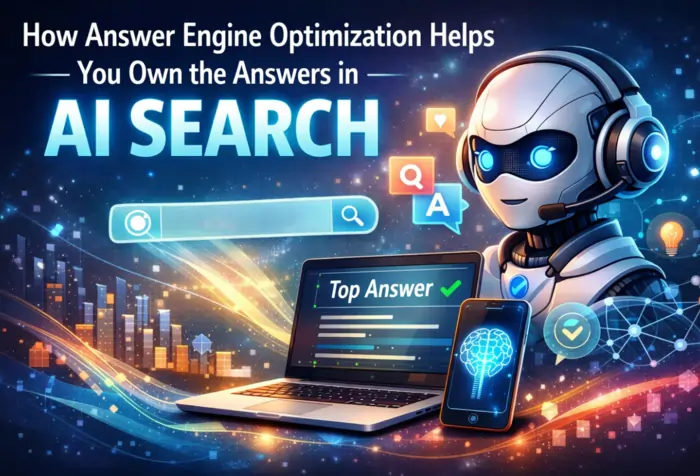
The question is How Answer Engine Optimization Helps You Own the Answers in AI Search?Most SEO strategies still revolve around chasing keyword rankings.
Learn how to shift from keyword-focused SEO to Answer Engine Optimization (AEO) so your content becomes the trusted answer that AI search engines and assistants quote.
Identify the questions your audience actually asks
Collect real questions from sales calls, support tickets, community threads, and SERP features like People Also Ask to see how your audience naturally searches.
Create question-based content hubs
Group related questions into clusters, then build answer hubs that cover definition, comparison, implementation, and troubleshooting queries on one well-structured page.
Write answer-first sections for humans and AI
Turn each core query into a heading and open with a clear 1–3 sentence answer, followed by supporting details, lists, and examples that are easy to scan and extract.
Add schema, FAQs, and entity context
Implement FAQ and HowTo schema where appropriate, keep your heading structure clean, and reinforce entities and author expertise so AI search systems can trust and reuse your content.
Measure answer visibility, not just rankings
Track featured snippets, People Also Ask placements, AI overview mentions, and branded search growth to understand how often your content is being used as the answer.
The problem is that users increasingly get their answers from AI overviews, rich snippets, and assistant‑style responses—often without ever clicking a result.
To stay visible in 2026, you need to shift from “How do I rank?” to “How do I become the answer?”
That shift is called Answer Engine Optimization (AEO). Instead of optimizing only for classic search results, you structure your content so AI search systems see it as a safe, high‑quality source to quote in their answers.
Table of Contents
Phase 1: The New Landscape
What AEO Actually Is (And Why It Matters)
Answer Engine Optimization is the practice of designing, structuring, and marking up content so AI‑enhanced search platforms and assistants can easily understand it and reuse it to answer user questions. Where traditional SEO focuses on pages and rankings, AEO focuses on questions and answers.
AEO‑aware content:
- Makes the primary question and the core answer obvious.
- Provides enough context for an AI to quote you without misrepresenting you.
- Includes clear structure and signals of expertise so you’re a low‑risk source to surface.
If you want a deeper primer, see:
- SEO Mafia Club – My guide: Answer Engine Optimization: How AEO Works in the AI & SEO Era
AEO vs SEO: Same Foundation, New Goal
You don’t throw away SEO; you layer AEO on top of it.
- SEO makes your site discoverable, crawlable, and indexable, and helps it rank based on relevance, links, and UX.
- AEO shapes that same content so AI systems can identify “this is the question” and “this is the best answer,” then confidently show or quote you in AI results.
For a clear breakdown of AEO vs SEO, see AEO vs. SEO: Key Differences and Importance in Digital Marketing from SEO.com.
The takeaway: SEO gets you into the index; AEO gets you into the answer.
Phase 2: Strategic Planning
From Keyword Lists To Question Maps
In an AEO world, you don’t start with a spreadsheet of disjointed keywords—you start by mapping the questions your audience actually asks and turning those into structured question maps that align with how answer engines understand intent.
Begin by collecting question‑based queries from real conversations (sales calls, support tickets, community threads), SERP surfaces like People Also Ask and related questions around your core topics, and tools that highlight question‑type and conversational keywords (for example, filters focusing on “what,” “how,” “why,” and “which”).
Then group those queries into tight clusters that reflect a journey: definition questions (“What is Answer Engine Optimization?”), comparison questions (“AEO vs SEO vs GEO”), implementation questions (“How do I structure content for AI search?”), and troubleshooting questions (“Why aren’t my pages showing in AI overviews?”).
Each cluster feeds into a single “answer hub” page on your site, making it far easier for modern answer engines and topic‑cluster‑driven SEO strategies to see what you cover, how deeply you cover it, and when your content is the best match for a user’s prompt.
Plan Around Questions, Not Just Phrases
In a keyword‑first world, you start with volumes and difficulty scores. In an answer‑first world, you start with the questions your audience actually asks.
Useful sources for question‑based research:
- Questions from sales calls, discovery forms, and support tickets.
- SERP elements like People Also Ask and related queries around topics such as AEO and AI search.
- AI‑aware tools and logs that show conversational queries, a key theme in many 2026 AEO guides.
Instead of writing one post per minor keyword variation, you group these questions into “answer journeys”:
- Understand – “What is AEO?” “Why does it matter in 2026?”
- Compare – “AEO vs SEO vs GEO: what should I prioritize?” (see SEO vs AEO vs GEO)
- Implement – “How do I structure a page so AI uses my answer?”
- Optimize – “How do I measure whether AI is citing me?”
Each journey becomes an “answer hub” page that covers a cluster of related questions, rather than scattering them across dozens of thin posts.
Phase 3: Content Execution & Formatting
Writing So Humans And AI Can Lift Your Answers
Write so each section works as a stand‑alone answer.
Turn core queries into headings
(“What is Answer Engine Optimization?”,
“How does AEO work with SEO?”),
then open with a tight 1–3 sentence reply before adding details. Keep key information in clean headings, short paragraphs, bullets, and simple tables so humans can scan quickly and AI systems can clearly see “here’s the question, here’s the answer” and lift it accurately.
Make Each Section Answer‑First
When an AI system scans your content, it looks for a familiar pattern: a clear question and a direct, self‑contained answer. You can support that by:
- Turning your main queries into headings like “What is Answer Engine Optimization?” and “How does AEO work with SEO?”.
- Opening each section with a concise 1–3 sentence answer.
- Adding explanation, examples, and nuance after that answer, not instead of it.
This answer‑first style is easy for humans to skim and for models to extract, and it aligns with layouts used in many current AEO guides and trend pieces.
Use Formats That Are Easy To Extract
Answer engines are more likely to reuse content that’s structurally clear:
- Short paragraphs for definitions and explanations.
- Bullet lists for steps, benefits, and key points.
- Simple tables for comparisons (for example, AEO vs SEO vs GEO).
Keep your HTML honest—real headings, lists, and paragraphs—so models can reliably identify each part of the answer.
Multimodal AEO: Optimizing Text, Images, And Video
AI answer engines are increasingly multimodal: they can read text, analyze images, and interpret video transcripts. That means your non‑text assets can help you own answers too.
Practical multimodal steps:
- Images: Add descriptive alt text and captions that summarize the insight in the chart or screenshot.
- Video: Put the main answer in the first 30–60 seconds and align chapters or timestamps with your core questions (“What is AEO?”, “How to add FAQ schema?”).
- Audio/voice: Draft key definitions and how‑to steps so they sound natural and unambiguous when read aloud.
For a broader view of how engines consume different media types, see this overview of multimodal AI models.
Phase 4: Technical Authority & Trust

Technical AEO
Technical AEO is about making your answers crystal‑clear not just for people, but for machines.
Schema, Structure, And Entities
You want your pages to have a clean HTML structure, the right schema, and well‑defined entities so AI systems can see exactly what you’re saying, who’s saying it, and how it fits into the bigger knowledge graph.
At the structural level, use a logical heading hierarchy (H1 → H2 → H3), short paragraphs, and proper lists and tables so potential answer blocks are easy to isolate—checklists like “Structured Data in AEO” break this down well: https://higoodie.com/blog/structured-data-in-aeo.
Then layer in AEO‑relevant schema types like FAQPage, HowTo, and Article to explicitly tag question‑and‑answer pairs and step‑by‑step processes, as shown in guides on schema that moves the needle for AEO and tutorials on how to implement schema markup for AEO.
Finally, support this with entity‑level schema (Organization, Person, Product, etc.) and strong E‑E‑A‑T signals—clear authorship, real experience, and topical depth—following best practices from resources like “Mastering Google’s 2026 SEO Formula: E‑E‑A‑T, GEO & AEO” and “Mastering SEO Entities in 2026”:
- E‑E‑A‑T, GEO & AEO: https://blog.mavigadget.com/mastering-googles-2026-seo-formula-e-e-a-t-geo-aeo-for-future-rankings/
- SEO entities: https://wireinnovation.com/mastering-seo-entities/
Make Your Structure Machine‑Readable
AEO performs best when your site is easy for machines to crawl and interpret. Core structural steps include:
- Using a clean heading hierarchy (H1 → H2 → H3) that mirrors user questions.
- Separating sections for FAQs, how‑tos, and definitions.
- Keeping URLs and internal links logical so topic clusters are obvious.
Then add schema where it fits your content:
- FAQPage for Q&A sections.
- HowTo for step‑by‑step guides.
- Article/BlogPosting for in‑depth resources.
These patterns match what you’ll find in modern AEO 101‑style guides and structured data best practices.
Clarify Who You Are (Entities and E‑E‑A‑T)
AI‑assisted search also leans on entity understanding (who/what you are) and trust signals similar to E‑E‑A‑T. To strengthen this layer:
- Keep author and about pages updated with real people, experience, and credentials.
- Use consistent naming for your brand and offers across your site and profiles.
- Build internal topic clusters for AEO, AI SEO, and related topics so engines see depth, not isolated posts.
For the conceptual foundation, Seobility’s overview of Answer Engine Optimization (AEO) is a helpful reference.
Use Human Evidence To Stand Out From AI Fluff
AI models can generate fluent text, but they’re weaker at simulating real‑world experience and specific, verifiable claims. That’s your edge.
To make your content a safer source to cite:
- Add first‑person observations (“In our test on 30 sites, we saw…”).
- Include concrete numbers and timeframes (“Over 90 days, adding FAQ schema increased snippet impressions by X%”).
- Show a brief process (“We added FAQPage schema on 10 articles and watched snippet visibility for 8 weeks…”).
These details make your content more persuasive for humans and help answer engines distinguish it from generic AI‑generated pages, a pattern highlighted in multiple 2026 AEO and AI search strategy reports.
Phase 5: Measurement & Next Steps
Measuring “Owning Answers” (Not Just Rankings)
If you adopt AEO but only track rankings and sessions, your progress may look invisible. Zero‑click experiences and AI overviews mean strong AEO can increase dark traffic—people see your answer inside AI results but never land on your site. Your visibility goes up while your analytics stay flat or even dip.
To understand whether you’re truly owning answers, you need additional signals:
- Growth in featured snippets, People Also Ask placements, and FAQ‑rich results.
- Presence in AI overviews and answer panels for your high‑value topics.
- Citations and mentions of your domain in third‑party answer engines and AI tools.
- Increases in branded search and direct visits that line up with improved answer visibility.
Specialized AI search analytics platforms (for example, tools in the LLM SEO tracking space) can help you see where your content appears inside AI outputs, not just on the SERP.
AEO Implementation Checklist
Use this quick checklist to scan your site for AEO readiness:
| Area | Question to Ask Yourself | Quick Action |
|---|---|---|
| Strategy | Have I mapped real user questions, not just keywords? | Pull questions from sales/support and SERP “People Also Ask”. |
| Content | Does each key page lead with a clear, direct answer? | Rewrite intros to be answer‑first in 1–3 sentences. |
| Structure | Can an AI see which section answers which query? | Add question‑based H2/H3s and short answer blocks. |
| Schema | Have I labeled FAQs and how‑tos for machines? | Implement FAQPage and HowTo schema where relevant. |
| Entities & E‑E‑A‑T | Is it obvious who we are and why we’re credible? | Update author bios, cluster related AEO/AI SEO content. |
| Measurement | Am I tracking the answer layer, not just rankings? | Monitor snippets, AI overviews, and branded search. |
Where To Go Next
If you’re ready to move from keyword chasing to answer ownership, start small and deliberate:
- Choose one high‑impact topic (for example, AEO for your niche).
- Collect all the real questions users ask on that topic.
- Build a single answer hub that covers that cluster with answer‑first sections, FAQs, and supportive media.
- Add schema and tighten internal links so it’s machine‑readable and clearly positioned as the hub.
- Monitor answer‑layer visibility alongside rankings and traffic, and adjust based on what earns citations.
For more depth and examples, these resources are excellent next steps:
- SEO Mafia Club – Answer Engine Optimization: How AEO Works in the AI & SEO Era
- CXL – Answer Engine Optimization (AEO): The Comprehensive Guide
- SEO.com – AEO vs. SEO: Key Differences and Importance in Digital Marketing
Build those habits, and your SEO stops being a constant scramble for the next keyword. Instead, you position your site as the place where both humans and AI systems go when they need a clear, trustworthy answer.
You May Also Like
- Why E-E-A-T Is the Core of SEO in 2026
- AI Marketing Automation: How to Turn Data Into Always‑On Revenue
- From Code to Rankings: Technical SEO & Full-Stack Development for Digital Brands
- What Is TikTok SEO? Beginner-Friendly Overview for 2026
- The Great SEO Shift: Why YMYL Sites Are Losing Rankings in 2026
- 18 Years In: Why I Won’t Quit SEO in the Age of AI
- Grey Hat SEO 2026: The Complete Guide to Ranking Fast (Without Getting Penalized)
- PPC Automation With DataSlayer, GoLogin and Google Sheets
- SEO Predictions for 2026: What Really Matters This Year

Hi, I’m Jean, but almost everyone knows me as Jin Grey. The name wasn’t something I created for branding—it grew naturally from who I am and how I work. “Jin” comes from my real name, Jean, and “Grey” represents the unconventional way I approach SEO and digital problem-solving. I’ve always been the kind of person who sits between extremes—creative yet analytical, strategic yet flexible, ethical yet realistic. Grey Hat SEO fit me perfectly, so the name stayed.