
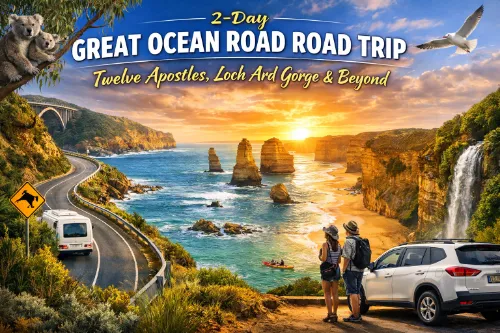
Destination guide overview
This article is part of a simple, practical Destination guide for Australia, focused on a 2–day Great Ocean Road road trip. A 2–day Great Ocean Road itinerary is the sweet spot if you want iconic coastal views, time for short walks, and relaxed overnights without turning the whole trip into a blur of driving.
This guide is written for a Great Ocean Road self drive, but you can also use it to compare self drive vs tour options and see which style suits you.
When I followed this 2–day loop from Melbourne, one of the biggest surprises was how quickly conditions changed: we left the city under clear blue skies, met coastal wind in Torquay, and arrived at the Twelve Apostles in soft, misty light.
That mix of surf beaches, rainforest detours, and dramatic cliffs is exactly what makes this Victoria coastal road trip so memorable.
For more background before you go, the official Guide to the Great Ocean Road by Tourism Australia is a useful overview of seasons, highlights, and must‑see stops.
Trip at a glance
Route: Melbourne → Torquay → Bells Beach → Lorne → Apollo Bay → Twelve Apostles → Loch Ard Gorge & Shipwreck Coast → inland return to Melbourne
- Duration: 2 days / 1 night
- Total distance: roughly 500–600 km round trip, depending on detours
- Driving time: around 8–10 hours of actual driving across the two days (not counting stops)
- Best time: late October to April for longer daylight and better beach/weather conditions
- Ideal for: first‑timers to Australia, couples, friends, and families
The official Great Ocean Road stretches about 243 km between Torquay and Allansford, but most Great Ocean Road road trips from Melbourne cover extra kilometres before and after that section.
In this 2 day Great Ocean Road itinerary you will visit classic Great Ocean Road attractions like Torquay, Lorne, Apollo Bay, the Twelve Apostles, Loch Ard Gorge, London Bridge (London Arch), and the Bay of Islands.
You will also drive through Great Otway National Park and Port Campbell National Park and experience the wild Shipwreck Coast.
For official trip planning tools, maps, and regional suggestions, check the Plan Your Trip page on Visit Great Ocean Road.
Planning your Great Ocean Road road trip
Self drive vs tour
This itinerary is designed as a Great Ocean Road self drive so you can stop where you like, when you like. A Great Ocean Road tour can still be a good option if you do not want to drive, but tours typically follow fixed timetables and may not linger long at places you love.
Confident drivers who are comfortable on winding roads usually prefer a self drive Great Ocean Road road trip for the flexibility.
Car hire and driving basics
Most travellers hire a car in Melbourne’s CBD or at Melbourne Airport. When you book, make sure your rental includes enough kilometres for a full 2–day loop and check what happens if you pick up and drop off at different locations (if you are not returning to Melbourne).
In Australia you drive on the left side of the road and the driver’s seat is on the right, so build in a bit of adjustment time if you are used to driving on the right.
The coastal sections are famous for their curves and cliffside views, which means this Great Ocean Road scenic drive can be tiring if you rush.
The Great Ocean Road safe driving tips from VicRoads strongly recommend slowing down, allowing longer braking distances, and taking plenty of breaks. Speed limits change frequently, and there are sharp bends, narrow shoulders, and occasional roadworks.
Give yourself extra time between towns, avoid driving when you are exhausted, and be patient with slower vehicles on tight sections.
For more safety guidance, the Road Safety advice on Visit Great Ocean Road explains local rules and conditions in simple terms.
Budget and practicalities
Your budget will mainly cover:
- Car hire and fuel
- Great Ocean Road accommodation (hotels, motels, cabins, camping, or caravan parks)
- Food and drinks along the route
- Optional activities (e.g., helicopter flight over the Twelve Apostles)
Fuel stations are found in Torquay, Anglesea, Lorne, Apollo Bay, and Port Campbell, but there are long stretches with no fuel between some towns. It is smart to top up in the larger centres instead of waiting for your tank to run low.
Mobile reception can drop out around Great Otway National Park and parts of Port Campbell National Park, so download offline maps and your Great Ocean Road map before you set off.
Summer school holidays (late December to late January) are the busiest period on the Great Ocean Road, with more traffic, higher prices, and crowded car parks at the most popular lookouts.
In winter, it is cooler and often wetter, but you may enjoy fewer crowds and very dramatic coastal scenery if you dress for the conditions.
If you want more context about how the coast and parks are managed, the Great Ocean Road Coast and Parks Authority shares updates and information about facilities and conservation works.
Day 1 – Melbourne to Apollo Bay via Torquay and Lorne
Morning: Melbourne to Torquay and Bells Beach
Leave Melbourne early to make the most of your first day. The drive from central Melbourne to Torquay is about 105 km and usually takes 1.5–2 hours depending on traffic and where you start.
Torquay is considered the gateway to the Great Ocean Road and is known for surf culture, coastal paths, and outlet stores.
From Torquay, it is about 7 km (roughly 10 minutes) to Bells Beach, one of Australia’s most iconic surf breaks and a great first viewpoint on any Great Ocean Road road trip.
Standing at the clifftop lookout above Bells Beach gives you that classic view of the powerful Southern Ocean, often dotted with surfers. On my trip, we paused here with takeaway coffee from Torquay and watched early‑morning surfers tackling long, rolling waves before moving on.
Back in the car, continue towards the Great Ocean Road Memorial Arch near Eastern View. This landmark is part of the story of the Great Ocean Road as the world’s largest war memorial, built by returned soldiers between 1919 and 1932. It is a popular photo stop, with a small parking area on the ocean side and a short path under the sign.
Midday: Lorne and Great Otway waterfall detours
From the Memorial Arch, follow the road along the coast to Lorne. The drive takes you through small settlements and past bays and headlands that show why this is one of the world’s most scenic coastal drives.
Lorne is a relaxed seaside town with a long beach, a pier, cafés, and restaurants and makes an excellent lunch stop on any Great Ocean Road itinerary.
If you have time after eating, consider detouring inland to Erskine Falls in Great Otway National Park. The falls lie roughly 8 km from Lorne and take about 15–20 minutes to reach on a narrow sealed road.
There is a small car park at the top and two main viewing platforms, one near the car park and one down a series of steps closer to the base. On my visit the car park filled quickly around late morning, so going earlier helped us avoid turning around due to lack of space.
Other waterfall options in the region include Sheoak Falls and Henderson Falls, but with only two days available you will want to choose just one or two short walks so you do not rush the rest of your Great Ocean Road road trip.
Afternoon: Lorne to Apollo Bay
The coastal drive from Lorne to Apollo Bay is around 45 km and takes roughly 1 hour without stops.
In reality, most Great Ocean Road self drive travellers spend longer because there are so many places to pull over for photos. Lookouts such as Teddy’s Lookout near Lorne provide sweeping views of the road snaking around the headlands with the ocean below.
This stretch is one of the most beautiful parts of a Victoria coastal road trip: dense green hills on one side, blue water and cliffs on the other.
Take advantage of safe viewpoints and signed lay‑bys rather than stopping in unsafe spots on the side of the road. Weather can shift fast, so having an extra layer nearby is handy when winds pick up.
Aim to arrive in Apollo Bay by late afternoon. Apollo Bay is a classic stop on a Great Ocean Road 2 day itinerary, with a wide beach and a compact centre filled with restaurants, pubs, and accommodation options.
When I drove this route, Apollo Bay felt like the perfect overnight base: big enough for plenty of food choices, small enough to feel like a beach town rather than a city.
Where to stay on Night 1
For this itinerary, Apollo Bay is the recommended base for the first night, but you can also choose Lorne if you prefer a shorter Day 1 or Port Campbell if you want to be close to the Twelve Apostles for sunrise. Apollo Bay offers a good balance:
- Central on the route between Lorne and the Twelve Apostles
- Wide range of Great Ocean Road accommodation options (motels, apartments, cabins, holiday parks)
- Easy beach access and sunset strolls
If you are camping or travelling in a campervan, look at caravan parks in Apollo Bay and nearby camping areas. The Visit Great Ocean Road accommodation listings are a good starting point for browsing stays by town and budget.
Free camping near the Great Ocean Road is possible in some inland forest reserves, but always check current regulations, fire restrictions, and safety advice before you set up.
Families often consider Apollo Bay one of the most family friendly Great Ocean Road towns because of the calm bay beach, playground, supermarkets, and relaxed vibe. For couples, there are also boutique stays and apartments with sea views.
Day 2 – Twelve Apostles, Loch Ard Gorge & beyond
Early morning: Apollo Bay to the Twelve Apostles
Leave Apollo Bay early on Day 2 so you can reach the Twelve Apostles around sunrise or soon after. The drive from Apollo Bay to the Twelve Apostles car park via the Great Ocean Road is about 110 km and generally takes 2–2.5 hours depending on traffic and stops.
This leg passes through more of Great Otway National Park and then heads inland over farmland before rejoining the coast near Port Campbell National Park.
If you want to see the coastline from below, first stop at Gibson Steps, which is close to the Twelve Apostles main lookout.
A stairway leads down to the beach when conditions are safe, giving you a view of towering cliffs and sea stacks from the sand. It is a powerful way to feel the scale of the landscape, especially early in the morning when there are fewer people.
On my trip we reached the Twelve Apostles boardwalk about 30 minutes before sunrise.
There were already a few campervans in the car park but the viewing platforms were still quiet, and we had plenty of space to move between lookouts as the sky shifted from grey to gold. If photography is important to you, aim for similar timing.
Twelve Apostles experience
The Twelve Apostles are the headline stop on most Great Ocean Road attractions lists. A network of paths and viewing platforms gives you several angles on the limestone stacks. You can easily spend 30–60 minutes here, more if you wait for different light or crowds to thin.
If you want an extra‑special perspective, consider booking a helicopter flight over the Twelve Apostles with an operator based near the visitor centre; many itineraries link to options from the official 12 Apostles tourism pages.
Short scenic flights offer views of the coastline, the stacks, and neighbouring bays and are particularly striking on clear days. It is not essential to enjoy your Great Ocean Road road trip, but it is one of those “once in a lifetime” extras that many travellers remember most vividly.
Late morning: Loch Ard Gorge and Shipwreck history
A short drive from the Twelve Apostles brings you to Loch Ard Gorge in Port Campbell National Park, one of the most dramatic sections of the coast and a must‑see on any Great Ocean Road itinerary.
Here, steep orange and cream cliffs surround a sheltered sandy beach and a narrow opening to the sea. The area is named after the ship Loch Ard, which wrecked nearby in 1878.
Several managed walks start from the main Loch Ard Gorge car park, each focusing on a different theme:
- A Geology Walk that highlights rock formations and erosion
- A Loch Ard Wreck Lookout walk that shares the story of the shipwreck
- Clifftop paths like Living on the Edge with views over Mutton Bird Island, Thunder Cave, and Broken Head
Trails range from around 200 m to 3 km, and the official Loch Ard Gorge walks guide on Visit Great Ocean Road suggests allowing 2–3 hours to explore the precinct. Most visitors spend at least 60–90 minutes here, combining two or more short walks and time at lookouts.
On my visit, strong winds meant beach access was temporarily closed, but the clifftop circuits still felt immersive enough to understand the power of the waves and the scale of the gorge.
This whole area belongs to the Shipwreck Coast, a stretch of shoreline with dozens of recorded wrecks between Cape Otway and Port Fairy. Information boards and online resources share some of the more dramatic stories, adding depth to your Great Ocean Road travel guide experience.
Afternoon: London Bridge, The Grotto, and Bay of Islands
After Loch Ard Gorge, continue west to visit other key viewpoints in and around Port Campbell National Park:
- The Arch: A natural rock arch carved by the sea, visible from a short boardwalk.
- London Bridge (London Arch): Once connected to the mainland before part of the arch collapsed, leaving a separate rock island.
- The Grotto: A partially enclosed rock pool framed by an arch, best seen when the tide and light are right.
Each stop has its own parking area and short, well‑marked paths. None require long hikes, which makes them easy additions even on a packed Great Ocean Road 2 day itinerary.
Further west, the Bay of Martyrs and the Bay of Islands Coastal Park offer a more open and often quieter series of viewpoints with scattered limestone stacks and islands.
Many travellers say that while the Twelve Apostles are the most famous, the Bay of Islands is just as impressive and less crowded.
If your schedule allows, you can continue to Warrnambool or Port Fairy and stay another night, effectively turning this into the start of a longer Victoria coastal road trip. For most 2–day travellers, however, this is the turning point where you begin the inland drive back to Melbourne.
Return to Melbourne
From the Port Campbell or Bay of Islands area, the inland drive back to Melbourne is faster and more straightforward than retracing every bend along the Great Ocean Road. Depending on your exact starting point and route, expect roughly 3–4 hours of driving back to the city.
After a full day of viewpoints and walks, this simpler road is safer and less tiring. The VicRoads Great Ocean Road map and safety PDF is a good reference for planning your return leg.
Food and drink along the Great Ocean Road
One of the pleasures of a Great Ocean Road road trip is the string of small towns where you can stop to eat, stock up on snacks, and sample local products.
- Torquay: Good for early coffee stops, bakeries, and casual breakfasts before you fully hit the road.
- Lorne: Plenty of cafés, beachfront restaurants, and takeaways for lunch on Day 1.
- Apollo Bay: Ideal for dinner on Night 1, with seafood restaurants, pubs, and simple takeaways.
- Port Campbell: A handy lunch or early dinner stop on Day 2, with spots looking over the bay.
Opening hours in smaller towns can be limited in low season or on certain days of the week, so it is wise to keep water and basic snacks in the car. Families, in particular, benefit from having quick food handy between major towns.
The Visit Great Ocean Road “places to eat” and “towns” sections are handy for checking current venues.
Packing and safety tips
To keep this Great Ocean Road itinerary smooth and safe, think in terms of layers, visibility, and simple comfort:
- Pack a light rain jacket and warm layer, even in summer. Wind on clifftops can be much cooler than temperatures in town.
- Wear comfortable walking shoes suitable for uneven tracks, stairs, and damp surfaces near waterfalls and coastal viewpoints.
- Bring sunscreen, a hat, and sunglasses; you will spend a lot of time outdoors with limited shade.
- Carry a reusable water bottle and refill it in towns to stay hydrated.
Parking can be tight at popular viewpoints, especially midday at the Twelve Apostles and Loch Ard Gorge. Arriving early or later in the afternoon helps, as does being flexible about the exact order of your stops on Day 2.
Always park only in designated areas; do not block roads or stop in unsafe places on the shoulder just for a photo.
Wildlife is another safety concern. Kangaroos, wallabies, and other animals may cross roads at dawn and dusk, especially near forested parts of Great Otway National Park. Drive more slowly in these areas, watch the verges, and avoid night driving where possible.
For official advice, the road safety tips from Visit Great Ocean Road and the VicRoads safety PDF linked above are both worth reading.
FAQs about a 2–day Great Ocean Road road trip
Is 2 days enough for the Great Ocean Road?
Yes, 2 days is enough to drive the Great Ocean Road and see the main highlights, including Torquay, Lorne, Apollo Bay, the Twelve Apostles, and Loch Ard Gorge. You will cover roughly 500–600 km over two days with time for short walks and viewpoints.
Can you do the Great Ocean Road in one day from Melbourne?
Yes, you can do a Great Ocean Road day trip from Melbourne, but it usually means 10–12 hours out, with long stretches of driving and less time at each stop. A 2–day Great Ocean Road road trip is more relaxed and gives you more time at the places you care about.
Which direction is best for a Great Ocean Road road trip?
The most popular direction is Melbourne → Torquay → Lorne → Apollo Bay → Twelve Apostles → inland return to Melbourne. This follows the coast westwards and avoids repeating every bend on the way back.
Is a tour or self drive better on the Great Ocean Road?
A guided tour is better if you do not want to drive or have very limited time. A self drive Great Ocean Road road trip is better if you want control over your schedule, more photo stops, and the flexibility to add waterfalls or extra lookouts.
Is the Great Ocean Road family friendly?
Yes, the Great Ocean Road is family friendly as long as you plan shorter driving legs and regular breaks. Towns like Lorne, Apollo Bay, and Port Campbell have toilets, open spaces or playgrounds, and easy access to beaches.
How long is the Great Ocean Road?
The official Great Ocean Road between Torquay and Allansford is about 243 km long. Most road trips from Melbourne add distance at each end, especially if you continue towards Warrnambool or Port Fairy.
How many hours does it take to drive the Great Ocean Road without stops?
Driving the official 243 km section without stopping takes roughly 4–5 hours, but almost no one does it that way. Most travellers take a full day or more to enjoy the lookouts and towns.
With this simple, experience‑based destination guide and 2 day Great Ocean Road itinerary, plus the official resources linked throughout, you have everything you need to plan your own Great Ocean Road road trip:
from Melbourne to Torquay and Lorne, through Apollo Bay and Great Otway National Park, out to the Twelve Apostles, Loch Ard Gorge, and the wider Shipwreck Coast, and safely back inland to the city.

I’m John Michael Palmes, an SEO practitioner with over three years of hands-on experience in search engine optimization and digital marketing. I help websites improve visibility, build effective SEO content strategies, and rank better on Google using practical, data-driven approaches.
My focus is on on-page SEO, keyword research, and content optimization—the fundamentals that help both search engines and users understand a site clearly. I continuously test, analyze results, and refine strategies, sharing honest and actionable SEO insights as search algorithms evolve.