Why Low-cost Index Funds Matter More Than Ever in 2026
In 2026, investors operate in a financial environment shaped by persistent inflation adjustments, shifting interest rate policies, AI-driven productivity growth, geopolitical realignments, and increasing retail participation in capital markets.
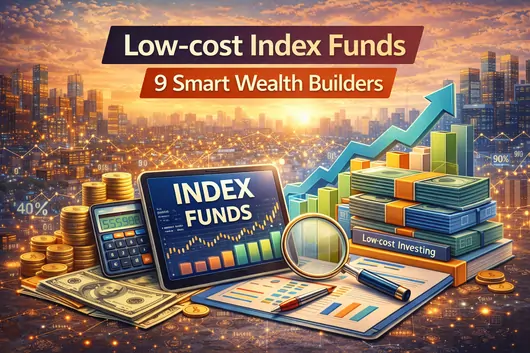
Amid this complexity, one strategy continues to stand out for its simplicity, transparency, and long-term reliability: investing in Low-cost Index Funds.
While markets evolve, one principle remains consistent—cost matters. Every percentage point paid in fees directly reduces net returns. Over decades, even small expense differences compound into substantial wealth gaps. That is precisely why Low-cost Index Funds have become foundational to modern portfolio construction.
Offering diversified exposure to broad market indices while minimizing management expenses. Instead of trying to outperform the market through active stock selection, they aim to replicate index performance at minimal cost. This approach appeals to:
- Long-term investors
- Retirement savers
- Passive investing advocates
- Cost-conscious portfolio builders
- Institutional allocators
This comprehensive guide explores nine smart wealth-building strategies centered around Low-cost Index Funds, examining performance dynamics, risk factors, tax efficiency, portfolio allocation models, and how to select the right fund for your goals.
Understanding the Foundation of Low-cost Index Funds
Before exploring advanced strategies, it is important to understand what makes Low-cost Index Funds unique.
What Are Index Funds?
Index funds are pooled investment vehicles designed to track a specific benchmark index such as:
- S&P 500
- Total U.S. Market
- NASDAQ 100
- MSCI World Index
- Aggregate Bond Index
Instead of active management, these funds replicate index holdings proportionally.
Specifically emphasize minimal expense ratios, often ranging between 0.02% and 0.20%.
Why Costs Matter So Much
Consider this simplified example:
- Investor A invests $100,000 at 8% annual return with a 0.05% expense ratio.
- Investor B invests $100,000 at 8% annual return with a 1% expense ratio.
After 30 years, Investor A may accumulate tens of thousands more simply due to lower fees.
The compounding effect makes Low-cost Index Funds one of the most powerful tools in long-term wealth creation.
The Structural Advantages of Low-cost Index Funds
Providing several structural benefits.
Broad Diversification
By tracking entire indices, investors gain exposure to hundreds or thousands of companies across sectors. This reduces single-stock risk significantly.
Transparency
Because they track public indices, holdings are known and predictable.
Lower Turnover
Minimal trading reduces transaction costs and tax events.
Tax Efficiency
Especially in ETF structures, Low-cost Index Funds often distribute fewer capital gains compared to active funds.
1. Smart Wealth Builder: Start with a Broad Market Core
The first strategy in leveraging Low-cost Index Funds is establishing a diversified core holding.
Total Market Funds
Total market index funds provide exposure to:
- Large-cap companies
- Mid-cap firms
- Small-cap stocks
This creates comprehensive coverage of domestic equity markets.
Why a Core Matters
A core allocation:
- Provides stable market exposure
- Reduces concentration risk
- Simplifies portfolio management
Low-cost Index Funds tracking total markets often serve as the backbone of long-term portfolios.
2. Smart Wealth Builder: Use S&P 500 Index Funds for Large-Cap Exposure
S&P 500 index funds remain among the most popular Low-cost Index Funds.
Benefits of Large-Cap Exposure
- Exposure to established companies
- Higher liquidity
- Strong historical growth trends
Large-cap companies often dominate innovation and global expansion.
Tracking the S&P 500 provide efficient access to corporate America’s largest enterprises.
3. Smart Wealth Builder: Diversify Internationally
Domestic markets do not represent the entire global opportunity set.
International Index Funds
International Low-cost Index Funds offer exposure to:
- Developed markets (Europe, Japan, Australia)
- Emerging markets (India, Brazil, Southeast Asia)
Benefits of Global Diversification
- Currency diversification
- Reduced domestic market reliance
- Access to faster-growing economies
Including international Low-cost Index Funds enhances resilience during regional downturns.
4. Smart Wealth Builder: Include Low-cost Bond Index Funds
Balanced portfolios often include fixed-income exposure.
Bond Index Fund Types
- Treasury bond funds
- Corporate bond funds
- Short-term bond funds
- Inflation-protected bond funds
Tracking bond indices provide:
- Income stability
- Reduced volatility
- Portfolio balance during equity downturns
Bond allocations moderate risk while preserving capital.
5. Smart Wealth Builder: Focus on Expense Ratio Discipline
Not all index funds are equally low-cost.
What to Look For
When evaluating Low-cost Index Funds, prioritize:
- Expense ratios below 0.20%
- Low tracking error
- High assets under management
- Strong liquidity
Fee discipline remains central to maximizing compounding benefits.
6. Smart Wealth Builder: Reinvest Dividends Consistently
Compounding accelerates when income is reinvested.
Dividend Reinvestment Strategy
Often distribute dividends. Reinvesting them:
- Increases share count
- Amplifies future returns
- Enhances long-term growth
Automatic dividend reinvestment builds wealth silently over time.
7. Smart Wealth Builder: Maintain Long-Term Perspective
Short-term volatility is inevitable.
Low-cost Index Funds are designed for:
- Decade-long investing horizons
- Retirement planning
- Generational wealth building
Investors who avoid emotional market timing often achieve superior results.
8. Smart Wealth Builder: Implement Periodic Rebalancing
Markets fluctuate, altering asset allocation.
Rebalancing Benefits
- Maintains target risk levels
- Prevents overconcentration
- Encourages disciplined profit-taking
Simplify rebalancing due to transparency and diversification.
9. Smart Wealth Builder: Automate Contributions
Consistency is more important than timing.
Dollar-Cost Averaging
Automatic monthly contributions to Low-cost Index Funds:
- Reduce timing risk
- Smooth volatility impact
- Build disciplined savings habits
Automation transforms investing from sporadic action into structured wealth accumulation.
Risks to Consider with Low-cost Index Funds
While powerful, Low-cost Index Funds are not risk-free.
Market Risk
Broad indices decline during recessions.
Concentration Risk
Market-cap-weighted funds may overexpose investors to mega-cap companies.
Limited Outperformance
Index funds match market performance—they do not aim to exceed it.
Understanding limitations improves strategic planning.
Comparing Low-cost Index Funds vs Active Funds
Active Funds
- Attempt to beat the market
- Charge higher fees
- Exhibit higher turnover
Index Funds
- Match index returns
- Minimize costs
- Offer predictable exposure
Over long periods, many active funds underperform after fees, reinforcing the appeal of Low-cost Index Funds.
Portfolio Allocation Example Using Low-cost Index Funds
A sample diversified portfolio might include:
- 50% Total Market Index Fund
- 20% International Index Fund
- 20% Bond Index Fund
- 10% Emerging Markets Fund
This structure balances growth and stability.
Making such diversified models cost-efficient and accessible.
Tax Considerations in 2026
Tax efficiency enhances net returns.
ETF Advantage
Many Low-cost Index Funds structured as ETFs use in-kind redemptions to reduce capital gains distributions.
Retirement Accounts
Tax-deferred accounts amplify compounding potential.
Understanding tax structures strengthens overall investment outcomes.
Behavioral Discipline and Wealth Growth
Investing success is often behavioral.
Low-cost Index Funds encourage:
- Patience
- Consistency
- Reduced emotional trading
- Long-term focus
Discipline is often more powerful than market forecasting.
Long-Term Outlook for Low-cost Index Funds
Future trends may include:
- Continued fee compression
- AI-enhanced index tracking
- ESG-focused index variations
- Greater global ETF adoption
These are likely to remain central to retirement planning and institutional asset allocation.
Key Takeaways
- Low-cost Index Funds minimize fees and maximize compounding.
- Broad diversification reduces single-stock risk.
- Expense ratios significantly impact long-term returns.
- International exposure enhances portfolio resilience.
- Bond index funds provide stability.
- Reinvested dividends accelerate growth.
- Automation strengthens consistency.
- Rebalancing maintains discipline.
- Tax efficiency improves net gains.
- Long-term patience is essential.

Frequently Asked Questions
What are Low-cost Index Funds?
These are investment funds that track market indices while maintaining minimal expense ratios.
Are Low-cost Index Funds safe?
They reduce single-company risk but remain subject to market volatility.
What expense ratio qualifies as low-cost?
Generally, below 0.20% is considered competitive.
Can Low-cost Index Funds outperform active funds?
Over long periods, many have outperformed active funds after fees.
Are ETFs better than mutual index funds?
ETFs often provide tax efficiency, but both can be effective.
Should beginners use Low-cost Index Funds?
Yes, they offer diversification and simplicity.
Do index funds pay dividends?
Yes, depending on underlying holdings.
How often should I rebalance?
Typically once per year.
Are international index funds necessary?
They reduce domestic concentration risk.
Will Low-cost Index Funds remain relevant in the future?
Yes, their cost efficiency and diversification appeal remain strong.

Mary Gay Apud is an SEO Strategist, Educator, and Research Consultant specializing in structured, data-driven organic growth systems. With a strong foundation in Mathematics, she applies analytical precision, research methodology, and strategic thinking to build scalable SEO frameworks that enhance search visibility and long-term authority.
Her expertise includes content optimization, keyword strategy, technical SEO, and topical authority development—aligning performance with measurable business outcomes. With experience in team leadership, statistical consulting, and government service, Mary Gay combines discipline, accuracy, and structured execution in every project. She believes sustainable digital success is built on research, clarity, and long-term strategic implementation—not short-term trends.