Why Web3 Business Models Matter in 2026
The internet is undergoing its third structural evolution. Web1 enabled static information. Web2 introduced interactive platforms powered by centralized corporations. Web3 is redefining digital ownership, decentralization, and value exchange through blockchain infrastructure.
In 2026, Web3 Business Models are no longer speculative experiments. They are reshaping finance, gaming, content creation, supply chains, creator economies, and digital identity systems. Venture capital, institutional funds, and enterprise innovators are increasingly allocating capital toward decentralized ecosystems.
However, Web3 Business Models differ fundamentally from traditional SaaS, advertising, or marketplace structures. They rely on token incentives, community governance, cryptographic ownership, smart contracts, and decentralized infrastructure.
Understanding Web3 Business Models is essential for founders, executives, investors, and policymakers who want to participate in blockchain-driven economies without misaligning incentives or misunderstanding risk exposure.
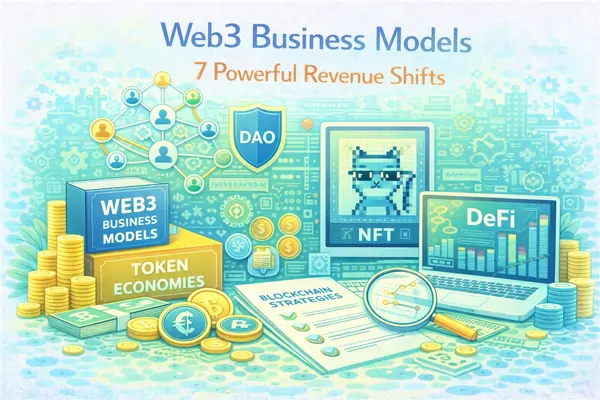
This comprehensive guide explores Web3 Business Models in depth. We will analyze token economies, DAOs, NFT monetization, DeFi protocols, infrastructure plays, creator ownership systems, and seven powerful revenue shifts transforming digital business strategy in 2026.
Understanding the Foundation of Web3
Before examining specific Web3 Business Models, it is important to define what makes Web3 structurally unique.
What Is Web3?
Web3 refers to decentralized applications and digital systems built on blockchain networks. Unlike Web2 platforms controlled by centralized corporations, Web3 platforms aim to distribute ownership and governance across participants.
Core components include:
- Smart contracts
- Cryptographic tokens
- Decentralized storage
- Wallet-based identity
- On-chain governance
- Peer-to-peer value exchange
These components create new possibilities for revenue generation.
How Web3 Differs from Web2
Traditional Web2 Business Models depend heavily on:
- Advertising revenue
- Subscription fees
- Data monetization
- Centralized infrastructure
Web3 Business Models introduce:
- Token-based incentives
- Decentralized governance
- Ownership-driven participation
- Automated smart contract revenue flows
This structural shift redefines how value is created and distributed.
1. Token-Based Revenue Models
One of the defining pillars of Web3 Business Models is the token economy.
Utility Tokens
Utility tokens provide access to a platform’s services. Companies may generate revenue through:
- Token sales
- Transaction fees
- Network participation costs
Unlike traditional equity, tokens often grant usage rights rather than ownership stakes.
Revenue is generated when:
- Users pay gas or transaction fees
- Applications require token staking
- Token utility increases demand
Governance Tokens
Governance tokens allow holders to vote on protocol decisions. These tokens may:
- Appreciate in value as adoption grows
- Provide treasury distribution rights
- Incentivize long-term ecosystem participation
Web3 Business Models often align revenue growth with token value appreciation.
Token Inflation vs Sustainability
Poorly designed token models can collapse under inflation pressure. Sustainable Web3 Business Models balance:
- Emission rates
- Real demand generation
- Utility-driven value creation
Strong tokenomics are foundational to long-term success.
2. Decentralized Autonomous Organizations (DAOs)
DAOs represent a governance-driven shift in Web3 models.
How DAOs Generate Revenue
DAOs may generate revenue through:
- Protocol fees
- NFT sales
- Investment returns
- Treasury staking
- Service contributions
Because decision-making is decentralized, participants share in value creation.
Governance Incentive Alignment
DAOs distribute power across token holders. This structure:
- Reduces centralized control
- Encourages transparency
- Aligns contributor incentives
However, governance concentration remains a risk.
Treasury Management
Effective Web3 models require disciplined treasury oversight. Poor capital allocation can undermine ecosystem sustainability.
3. DeFi Protocol Revenue Models
Decentralized Finance represents one of the most advanced examples of Web3 Business Models.
Lending and Borrowing Platforms
DeFi lending protocols generate revenue by:
- Charging interest spreads
- Collecting liquidation fees
- Implementing protocol fees
Smart contracts automate these revenue flows.
Decentralized Exchanges (DEXs)
DEXs earn revenue through:
- Trading fees
- Liquidity provider commissions
- Token swap spreads
Volume growth directly correlates with revenue.
Yield Aggregators
Yield aggregators optimize capital allocation across protocols and earn revenue via:
- Performance fees
- Management fees
Web3 Business Models in DeFi rely heavily on network liquidity.
4. NFT Monetization Strategies
NFTs extend Web3 Business Models into art, gaming, identity, and media.
Primary Sales Revenue
Creators generate revenue through:
- Initial NFT drops
- Limited edition releases
- Membership NFTs
Smart contracts ensure ownership verification.
Secondary Market Royalties
One of the most innovative Web3 Models involves automated royalty structures. Creators can earn a percentage of each secondary sale.
Utility-Based NFTs
NFTs may grant:
- Event access
- Exclusive content
- Voting rights
- Gaming advantages
This extends revenue beyond speculation into utility.
5. Play-to-Earn and GameFi Models
Gaming represents a powerful evolution within Web3 Business Models.
In-Game Token Economies
Players earn tokens through:
- Gameplay participation
- Asset trading
- Tournament wins
Developers earn through:
- Token issuance
- Marketplace fees
- NFT asset sales
Asset Ownership Shift
Unlike Web2 games, players truly own digital assets in Web3 ecosystems. This ownership model redefines user engagement.
However, sustainability depends on balanced token supply and demand.
6. Infrastructure and Blockchain-as-a-Service
Not all Web3 Business Models involve tokens directly.
Node Infrastructure
Companies may operate blockchain nodes and earn revenue through:
- Staking rewards
- Transaction validation fees
Developer Tooling
Web3 infrastructure firms provide:
- API services
- Smart contract auditing
- Security solutions
Revenue is generated via subscription models similar to SaaS.
Layer-2 Scaling Solutions
Scalability platforms generate income by:
- Charging network fees
- Licensing enterprise solutions
Infrastructure remains one of the most stable Web3 Models.
7. Creator and Ownership Economies
Web3 Business Models empower creators to monetize directly.
Tokenized Communities
Creators launch tokens that:
- Provide membership access
- Grant voting privileges
- Unlock exclusive experiences
Revenue aligns with community growth.
Direct Fan Monetization
Without centralized intermediaries, creators:
- Retain higher revenue shares
- Avoid advertising dependency
- Build long-term ownership-based ecosystems
This shift transforms the creator economy.
Risks Associated with Web3 Business Models
While innovative, Web3 Business Models carry risk.
Regulatory Uncertainty
Token classification remains subject to regulatory interpretation. Compliance misalignment may:
- Restrict exchange listings
- Trigger enforcement action
- Impact token liquidity
Smart Contract Vulnerability
Code exploits can drain treasury funds.
Market Volatility
Token-based revenue fluctuates with market conditions.
Governance Capture
Token concentration may undermine decentralization.
Understanding these risks is essential for strategic execution.
Financial Sustainability in Web3 Business Models
Revenue alone does not guarantee sustainability.
Aligning Incentives
Successful Web3 Business Models align:
- Developer incentives
- User rewards
- Investor returns
Misalignment often leads to token collapse.
Real Demand vs Speculation
Revenue driven purely by speculation is fragile. Sustainable models generate:
- Genuine utility
- Network activity
- Recurring transaction volume
Treasury Diversification
Diversifying treasury assets reduces exposure to market volatility.
Comparing Web3 Business Models to Traditional Models
Traditional businesses monetize through centralized control. Web3 Business Models monetize through distributed participation.
Key differences include:
- Ownership distribution
- Revenue automation via smart contracts
- Transparent on-chain accounting
- Tokenized incentive systems
These differences reshape competitive dynamics.
How to Evaluate Web3 Business Models
Investors should assess:
- Token utility
- Revenue generation mechanisms
- Governance transparency
- Developer credibility
- Audit history
- Treasury management
- Market demand
Comprehensive due diligence reduces exposure.
Long-Term Outlook for Web3 Business Models
Looking beyond 2026, Web3 Business Models may integrate with:
- Central bank digital currencies
- Tokenized securities
- Regulated DeFi platforms
- Enterprise blockchain solutions
Institutional participation may stabilize revenue structures.
Hybrid models combining Web2 efficiency with Web3 ownership may dominate the next decade.
Key Takeaways
Web3 Business Models redefine digital ownership and revenue generation.
Token economies drive decentralized incentives.
DAOs distribute governance across participants.
DeFi protocols automate financial services revenue.
NFTs enable programmable royalties.
GameFi introduces asset ownership dynamics.
Infrastructure plays offer stable blockchain revenue streams.
Regulatory clarity remains essential.
Sustainable tokenomics determine longevity.
Strategic due diligence protects capital allocation.
Frequently Asked Questions
What are Web3 Business Models?
Refers to revenue structures built on decentralized blockchain ecosystems using tokens, smart contracts, and community governance.
How do Web3 Business Models generate revenue?
They generate revenue through transaction fees, token issuance, staking rewards, NFT sales, governance participation, and infrastructure services.
Are Web3 Business Models sustainable?
Sustainability depends on token utility, user demand, governance transparency, and long-term economic design.
What is tokenomics?
Tokenomics refers to the economic structure of a token, including supply, distribution, utility, and incentive mechanisms.
How do DAOs fit into Web3 Business Models?
DAOs decentralize governance and distribute revenue and decision-making power among token holders.
Are NFTs a valid business model?
NFTs can generate revenue through primary sales, royalties, and utility-based access models.
How does regulation affect Web3 Business Models?
Regulation influences token classification, exchange access, and compliance requirements.
What industries use Web3 Business Models?
Finance, gaming, creator economies, infrastructure services, supply chains, and digital identity platforms.
Can traditional companies adopt Web3 Business Models?
Yes, many enterprises are integrating blockchain solutions and tokenized incentives.
Is Web3 replacing Web2?
Web3 may complement rather than replace Web2, creating hybrid digital ecosystems.

Mary Gay Apud is an SEO Strategist, Educator, and Research Consultant specializing in structured, data-driven organic growth systems. With a strong foundation in Mathematics, she applies analytical precision, research methodology, and strategic thinking to build scalable SEO frameworks that enhance search visibility and long-term authority.
Her expertise includes content optimization, keyword strategy, technical SEO, and topical authority development—aligning performance with measurable business outcomes. With experience in team leadership, statistical consulting, and government service, Mary Gay combines discipline, accuracy, and structured execution in every project. She believes sustainable digital success is built on research, clarity, and long-term strategic implementation—not short-term trends.