
Why Working Capital Management Is Critical Today
Cash flow is the lifeblood of every organization. Regardless of how profitable a company appears on paper, it cannot survive without sufficient liquidity to meet short-term obligations.
Salaries, supplier payments, rent, utilities, loan repayments, and operational expenses all depend on effective liquidity planning. This is where Working Capital Management becomes a strategic priority for CEOs, CFOs, and business leaders.
Working capital represents the difference between current assets and current liabilities. It reflects a company’s short-term financial health and operational efficiency. When managed properly, it ensures smooth operations, improves supplier relationships, strengthens creditworthiness, and enhances growth capacity.
In 2026, economic volatility, supply chain disruptions, inflationary pressures, rising borrowing costs, and digital transformation trends making more critical than ever. Companies must balance liquidity with profitability while optimizing cash conversion cycles and minimizing operational risk.
This comprehensive guide explores Working Capital Management in depth. We will analyze its components, financial metrics, industry variations, risk factors, and seven powerful strategies that executives can implement to enhance cash flow stability and long-term business resilience.
Understanding Working Capital Management
Working Capital Management refers to the process of managing a company’s short-term assets and liabilities to ensure operational continuity and financial efficiency.
Working capital typically includes:
- Cash and cash equivalents
- Accounts receivable
- Inventory
- Accounts payable
- Short-term debt obligations
The objective of Working Capital Management is to maintain adequate liquidity while maximizing returns on current assets.
Positive vs Negative Working Capital
Positive working capital occurs when current assets exceed current liabilities. This generally indicates financial stability.
Negative working capital occurs when liabilities exceed assets. While sometimes efficient in retail or subscription models, it may signal liquidity stress in other industries.
Working Capital Management requires balancing these dynamics carefully to avoid both cash shortages and idle capital.
Why Working Capital Management Matters in 2026
The financial landscape is evolving rapidly. Working Capital Management now intersects with global supply chains, digital payment systems, real-time financial reporting, and ESG expectations.
Key reasons it matters:
- Protects against short-term liquidity crises
- Improves supplier and creditor relationships
- Reduces borrowing dependency
- Strengthens credit ratings
- Enhances investor confidence
- Supports strategic expansion
Without disciplined Working Capital Management, companies risk operational disruption, strained vendor relationships, and missed growth opportunities.
Key Components of Working Capital Management
To optimize Working Capital Management, leaders must understand its primary components.
Accounts Receivable Management
Accounts receivable represent money owed by customers. Effective management ensures timely cash inflows.
Key practices include:
- Establishing clear credit policies
- Conducting customer credit checks
- Offering early payment discounts
- Automating invoice reminders
- Monitoring aging reports
Efficient receivables management accelerates cash conversion and strengthens liquidity.
Inventory Management
Inventory ties up capital. Excess inventory increases storage costs and risk of obsolescence.
Working Capital Management requires balancing stock levels to avoid:
- Overstocking
- Stockouts
- Supply chain delays
Techniques such as just-in-time (JIT) systems and demand forecasting improve efficiency.
Accounts Payable Management
Accounts payable represent obligations to suppliers.
Strategic Working Capital Management involves:
- Negotiating favorable payment terms
- Leveraging early payment discounts selectively
- Aligning payment cycles with receivable collections
Managing payables effectively improves cash retention without harming supplier relationships.
1. Optimize the Cash Conversion Cycle
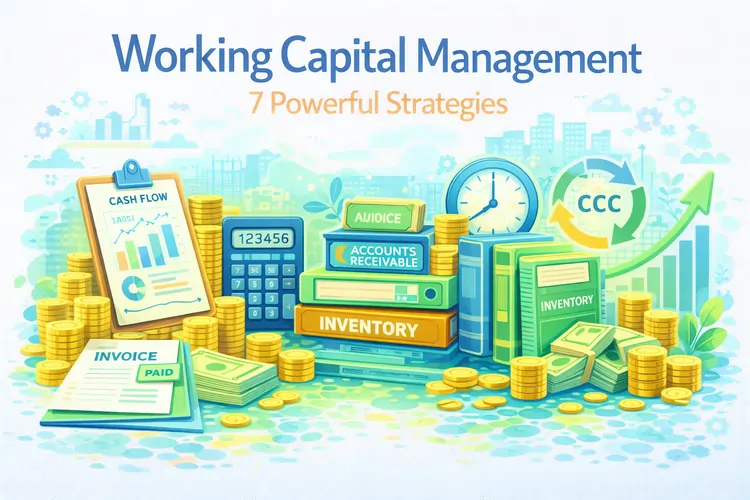
The cash conversion cycle (CCC) measures how long it takes to convert investments in inventory and receivables into cash.
The formula includes:
- Days Inventory Outstanding (DIO)
- Days Sales Outstanding (DSO)
- Days Payables Outstanding (DPO)
Reducing CCC strengthens Working Capital Management by accelerating cash flow.
Reduce DSO
Shorten customer payment timelines through digital invoicing and proactive collections.
Improve DIO
Enhance demand forecasting and inventory tracking systems.
Extend DPO Strategically
Negotiate extended payment terms without damaging supplier trust.
Optimizing CCC is foundational to effective Working on Capital Management.
2. Implement Strong Credit Policies
Credit management directly impacts liquidity.
Clear credit policies should define:
- Credit approval criteria
- Payment terms
- Late fee structures
- Collection procedures
Working Capital on Management improves when customer risk is assessed proactively.
3. Improve Inventory Forecasting
Advanced forecasting tools support better Working on Capital Management.
Strategies include:
- Historical sales analysis
- Real-time demand tracking
- Supplier performance evaluation
- Safety stock optimization
Reducing inventory inefficiencies frees up capital for reinvestment.
4. Leverage Technology and Automation
Digital transformation enhancing efficiency.
Modern tools include:
- ERP systems
- Automated invoicing software
- AI-driven demand forecasting
- Real-time financial dashboards
Automation reduces human error and accelerates cash cycle tracking.
5. Strengthen Supplier Relationships
Suppliers are strategic partners in Working Capital Management.
Negotiation strategies include:
- Volume-based discounts
- Extended payment terms
- Dynamic discounting agreements
Collaborative supplier relationships improve liquidity flexibility.
6. Maintain Liquidity Buffers
Liquidity buffers provide resilience during economic uncertainty.
Working Capital Management includes:
- Maintaining emergency cash reserves
- Securing revolving credit facilities
- Establishing contingency financing plans
Proactive liquidity planning protects operational continuity.
7. Monitor Key Financial Ratios
Data-driven analysis supports continuous improvement in Working on Capital Management.
Important ratios include:
Current Ratio
Measures ability to cover short-term liabilities.
Quick Ratio
Excludes inventory to assess immediate liquidity.
Inventory Turnover Ratio
Evaluates inventory efficiency.
Accounts Receivable Turnover
Measures collection effectiveness.
Regular monitoring enables strategic adjustments before issues escalate.
Industry Variations in Working Capital Management
Different sectors require tailored approaches.
Retail
Retail often operates with negative working capital due to upfront customer payments and delayed supplier payments.
Manufacturing
Manufacturing requires careful inventory control due to raw material costs.
Technology
Tech firms rely more on receivables and subscription models.
Strategies must align with industry structure.
Risks of Poor Working Capital Management
Ineffective Working Capital Management can lead to:
- Cash shortages
- Missed payroll obligations
- Supplier disputes
- Higher borrowing costs
- Reduced investor confidence
- Operational disruptions
Proactive management prevents these outcomes.
Working Capital Management in Growth vs Mature Companies
Growth-stage companies prioritize flexibility and scalability.
Mature firms focus on efficiency and dividend stability.
Evolving alongside company lifecycle stages.
The Impact of Economic Conditions
Macroeconomic factors influence liquidity strategies.
Interest rate increases raise borrowing costs.
Inflation affects inventory and supplier pricing.
Global disruptions impact supply chains.
Strategic Working Capital Management adapts to these variables.
Key Takeaways
Working Capital Management ensures operational liquidity.
Optimizing the cash conversion cycle accelerates cash flow.
Strong credit policies reduce receivable risk.
Inventory forecasting prevents capital inefficiency.
Automation improves financial visibility.
Supplier negotiations enhance flexibility.
Liquidity buffers protect against uncertainty.
Financial ratios guide proactive decision-making.
Industry context shapes strategy.
Continuous monitoring ensures long-term stability.
Frequently Asked Questions
What is Working Capital Management?
It’s the process of managing short-term assets and liabilities to maintain liquidity and operational efficiency.
Why is Working Capital Management important?
It ensures a company can meet short-term obligations while supporting sustainable growth.
What is the cash conversion cycle?
It measures the time required to convert inventory and receivables into cash.
How does inventory affect Working Capital Management?
Excess inventory ties up capital and increases storage costs.
What is a good current ratio?
Generally between 1.5 and 2.0, depending on industry standards.
How can technology improve Working Capital Management?
Automation and analytics enhance visibility and efficiency in cash flow tracking.
What causes negative working capital?
High short-term liabilities exceeding current assets.
Should companies maintain cash reserves?
Yes, liquidity buffers protect against unexpected disruptions.
How often should working capital be reviewed?
Monthly reviews are recommended for dynamic environments.
Does Working Capital Management affect profitability?
Yes, efficient liquidity management reduces financing costs and improves margins.

Mary Gay Apud is an SEO Strategist, Educator, and Research Consultant specializing in structured, data-driven organic growth systems. With a strong foundation in Mathematics, she applies analytical precision, research methodology, and strategic thinking to build scalable SEO frameworks that enhance search visibility and long-term authority.
Her expertise includes content optimization, keyword strategy, technical SEO, and topical authority development—aligning performance with measurable business outcomes. With experience in team leadership, statistical consulting, and government service, Mary Gay combines discipline, accuracy, and structured execution in every project. She believes sustainable digital success is built on research, clarity, and long-term strategic implementation—not short-term trends.